
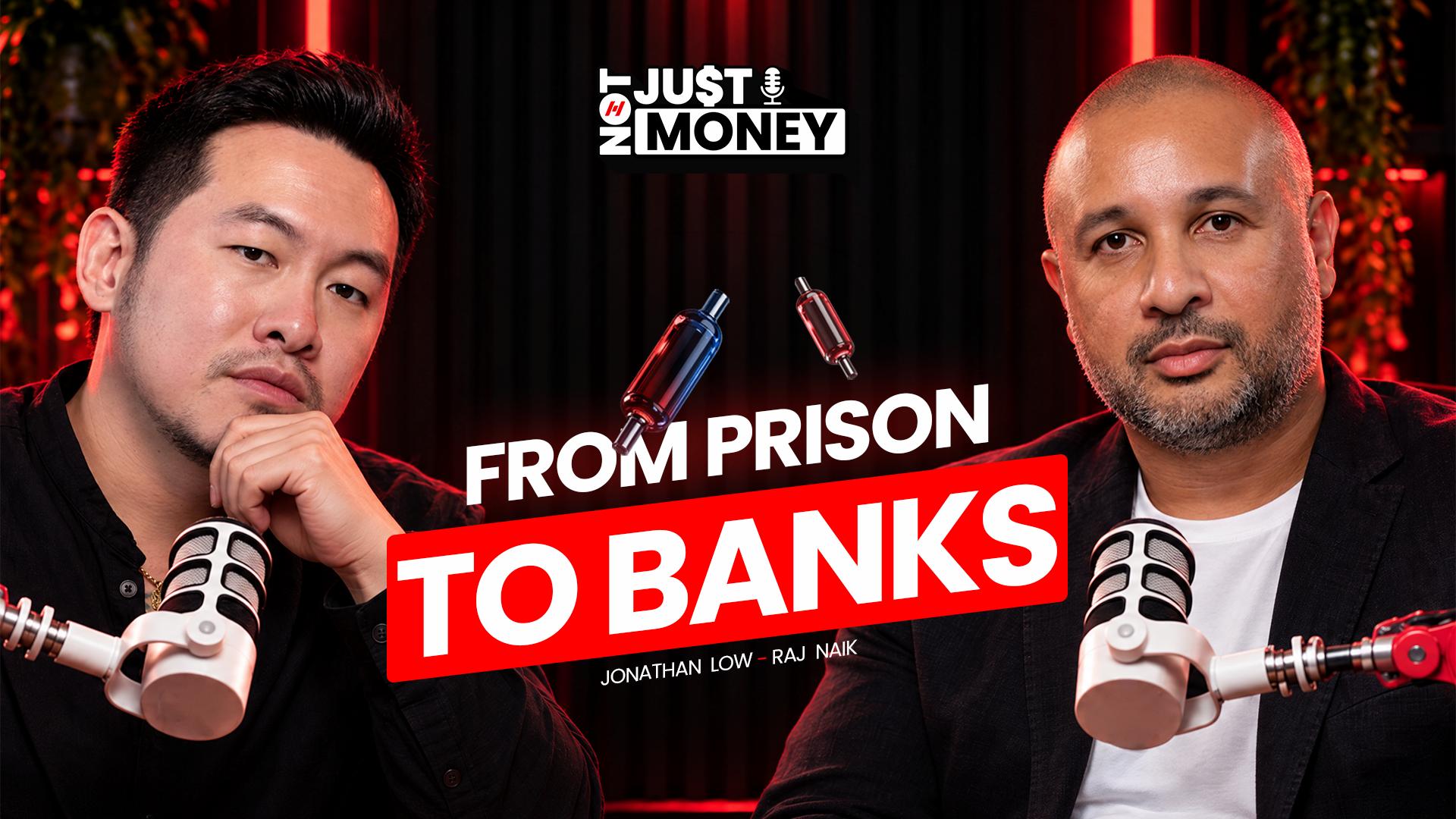
Jonathan Low, founder and CEO of BipTap and author of Cell to CEO, in conversation with Rajan Naik on the Not Just Money podcast.
Introduction
From Singapore’s gangs and nightlife to three years in one of Bangkok’s toughest prisons, Jonathan Low has lived several lives before founding BipTap. In this episode of Not Just Money, he tells Rajan Naik (Hantec Markets CMO) how prison reshaped his mindset, how he went on to build banking infrastructure for 46 partners, and what a costly betrayal by a friend of 17 years taught him about trust. He also gives his unfiltered views on money and AI.
Key Takeaways
- Rock bottom can be a launchpad. Jonathan’s turning point came in his second month in a Bangkok prison, when he stopped waiting to be rescued and accepted his sentence. He then used it to rebuild himself through reading, meditation, exercise and clear goals. His advice to anyone at rock bottom is to ask what it is there to teach them.
- Real change means letting go of the old self. He argues that adding new habits isn’t enough. After prison he cut off his old circle and committed to a new identity, because people stay stuck when they keep saying “that’s just who I am.”
- Keeping your word is a competitive edge. Doing exactly what he promises has been his biggest advantage in building BipTap. The company provides banking infrastructure for industries and countries that traditional banks underserve, and it now works with 46 partners.
- Trust should be earned, not given upfront. A failed deal with a friend of 17 years changed how he approaches trust. He now looks at what a partner has to lose, meets only people vouched for by those he trusts, and keeps a small, deliberate circle.
- In an AI world, authenticity is what stays human. He urges people and companies to adopt AI tools fully, though carefully if they are new to them. What AI can’t replicate, he says, is raw, flawed honesty, and being open about his own past is what sets him apart in an industry full of polished credentials.
From the Streets to a Prison Cell
Jonathan Low didn’t come from money. “I came from the streets, from the gangs, and I led a pretty rough life,” he tells Rajan Naik. He married at 21, hoping it would give him a reason to live differently, and for a while it worked. He built a model agency and several clubs, including one of the biggest in Singapore between 2011 and 2014.
Then nightlife took its toll. “The drinking, the substance abuse, the power and money, all at a very young age. Ego takes over.” A divorce followed, then a downward spiral, and eventually a three-year sentence in one of Bangkok’s toughest prisons. Looking back, he puts the cause down to having no direction: “I didn’t have a mentor, someone to look up to, or anyone to guide me.”
The Turning Point
The first two months were the hardest. There was constant noise and violence, and his lawyer kept promising bail that never came. “If you keep hoping you’ll go home tomorrow, it’s suffering,” he says. Everything shifted when he accepted his sentence. While praying for peace, he heard what he describes as a voice asking, “Weren’t you asking for change your whole life? This is it.”
From that moment, prison became a secret training ground. He set himself a mission to read, exercise, eat well and meditate, and to walk out a different person. “Samurai spend years in the mountains, and when they come back, they’ve found Zen,” he says. He began sharing what he learned with other inmates and saw how a few words could give someone hope. That experience later became his book, Cell to CEO, written for anyone trapped in their own “mental prison.”
Kill the Old Version First
For Jonathan, lasting change starts with identity, not habits. When he was released, he cut off his entire old circle. “A lot of people try to change by adding more things. I think differently. The fastest way to become the best version of yourself is to kill the old version first,” he says. “Then there’s nothing to go back to.”
The former troubled kid with anger problems is now known as the calmest person in the room, and he believes the shift began with refusing to say “that’s just who I am.”
Building BipTap
BipTap began in 2022 with a simple frustration: the crypto cards on the market weren’t available to Singaporeans. Jonathan built a prototype, then white-label cards, but saw the market heading for saturation. Digging into why people used crypto at all, his team found a deeper problem. Many legitimate businesses in industries like network marketing, iGaming and forex, along with entire countries across Africa, South Asia and the Caribbean, struggle to access banking.
Today BipTap provides banking infrastructure as a service, which Jonathan calls “the Airbnb of banking.” Rather than pushing one product, the company works with presidents, central banks and finance ministers to build solutions for each market. It now has 46 partners.
A Handshake Is Your Bond
His biggest business advantage, he says, is almost embarrassingly simple. “If I tell you I’ll do something, I’ll find every way to get it done. That’s it.” He describes himself as old-school, someone who believes that “brotherhood is everything, loyalty is everything, and a handshake is your bond.”
That loyalty was tested recently when a deal with a friend of 17 years fell apart and cost him reputation. The lesson changed how he approaches trust. He no longer gives it first. He looks at what a partner has to lose, meets only people vouched for by those he trusts, and keeps his circle small. “In finance and banking, you can’t afford to trust someone first, because that trust is worth millions of dollars.”
Money as Energy
For a show called Not Just Money, Jonathan’s view of money is practical. “Money is energy,” he says, something to exchange and reinvest rather than display. He puts his into relationships, his team and his company, and warns that without a clear goal, people simply spend to feel good. At 18, he dreamed of being a CEO in a suit. Now he is one, and his vision has grown to impacting millions of lives through his companies, his books and his story.
Going Full Blast on AI
On AI, his message is blunt. “The world isn’t going to slow down, whatever you think.” His company runs heavily on AI, and he personally uses seven or eight agents. His advice to beginners is more cautious: start slowly, learn from good educators, and never give an AI tool access to your computer if you don’t know what you’re doing.
What AI can’t replace, he argues, is authenticity. In an industry full of Harvard degrees and Wall Street credentials, he stands out by telling the truth: “Yes, I’ve been to prison. Yes, I have zero experience in banking. If you trust me, let’s go on this journey together.”
Rock Bottom as a Launchpad
His closing advice is for anyone at their lowest point. Ask what you’re meant to learn from it. He compares it to sinking in the sea: the person who touches the bottom first can kick off and reach the surface sooner. “If I hit rock bottom before you, I get the chance to be reborn faster, to learn faster, to see the light faster.”
It’s why he no longer fears failure. “I know failure will take me to greater heights,” he says. “I wouldn’t mind losing everything again.”
More from the Not Just Money Podcast
Not Just Money Podcast with Luis Garcia: From the Pitch to the Boardroom
Learn how Luis García moved from Liverpool F.C. to the boardroom. Discover his tips on financial literacy, leadership, and reinventing your career.
Not Just Money Podcast with Racha Al Khawaja: Why Your Emotions Are Losing You Money
Emotion-driven investing insights from Racha Al Khawaja: learn to manage fear, greed and risk, build discipline, and grow wealth through smart trading and financial literacy.
Disclaimer: The content of this article is intended for informational purposes only and should not be considered professional advice.