
Introduction: Trading Without the Stress
For many beginners, the biggest fear in trading is not losing money – it’s the pressure of feeling glued to charts all day. The constant alerts, flashing candles, and fear of “missing out” can make trading feel like a full-time job. Most people don’t want to stare at screens from morning to night – they simply want a calm, reliable way to grow their money.
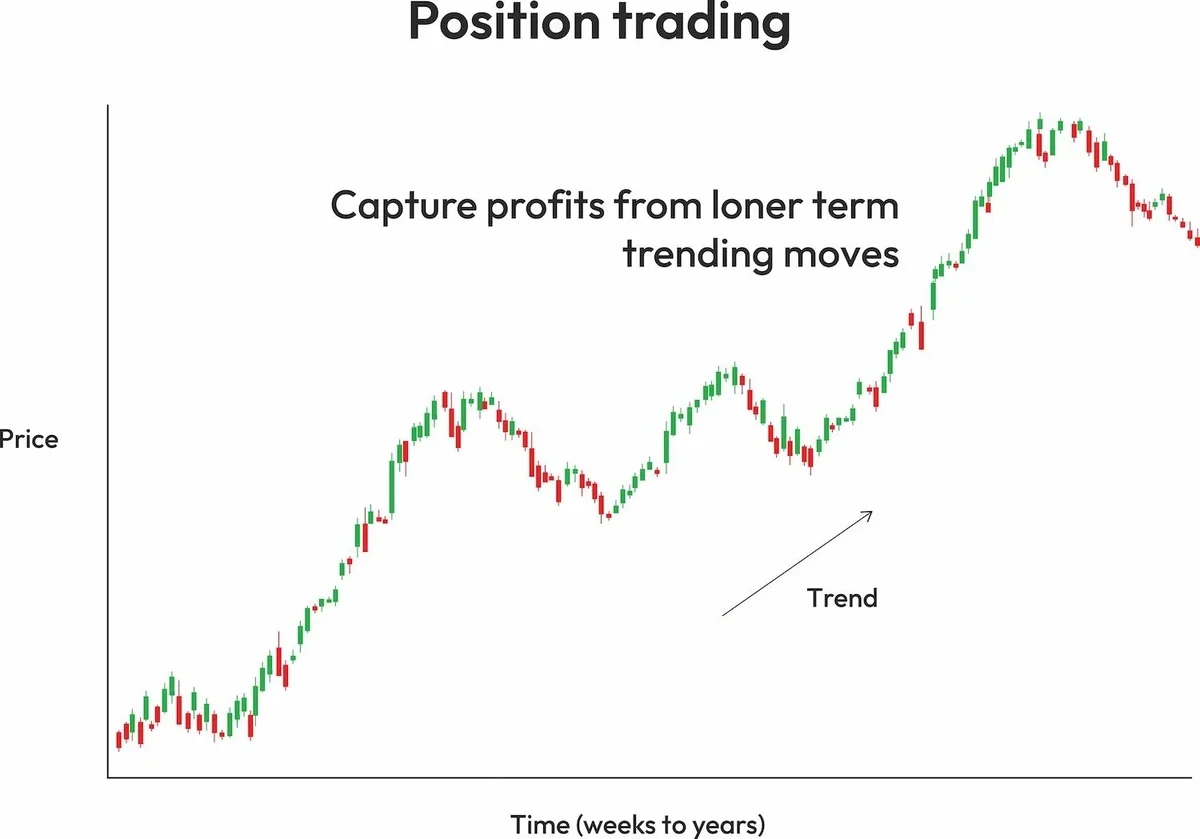
Position trading offers a refreshing alternative. Instead of chasing every price movement, this strategy focuses on identifying major market trends and holding positions for months – or even years. Rather than reacting to every bump in the market, position traders step back, look at the bigger picture, and allow long-term trends to unfold naturally.
In simple terms, position trading is a calm, patient approach where time does much of the work for you.
It shares similarities with long-term investing, but with one key difference: position traders use simple tools such as stop-loss orders and trend analysis to actively manage risk. Your time commitment is minimal, your stress level is low, and success relies far more on patience than on rapid decision-making.
For beginners looking for a simple, structured, and low-maintenance way to enter the markets, position trading is one of the most accessible and effective strategies available.
What Is Position Trading?
Position trading is a long-term style of trading where you hold an asset, such as a stock, index, currency pair, or commodity, for an extended period. The goal is to capture major, meaningful shifts in the market rather than short-term volatility.
Where day traders may make dozens of trades in a week, position traders might only place a handful in a year.
Position Trading vs. Investing
Although both approaches are long-term, they are not identical:
| Feature | Position Trading | Traditional Investing |
|---|---|---|
| Time Horizon | Months to years | Years to decades |
| Risk Management | Uses stop-loss orders | Very passive, rarely uses stops |
| Chart Use | Weekly/monthly charts | Minimal technical analysis |
| Focus | Capturing major market moves | Broad, slow wealth building |
Position trading sits in the middle: not too fast, not too passive. It provides structure without requiring constant attention.
Time Commitment & Stress Level
- Time Required: Very low (many traders check charts weekly or monthly).
- Stress Level: Low (short-term market noise is largely irrelevant).
- Ideal For: Beginners, long-term savers, and anyone seeking a calm trading experience.
If you want to grow your money without making trading your full-time job, position trading fits perfectly.
The Core Analysis
Successful position trading rests on two pillars: fundamental analysis (the “why”) and technical analysis (the “direction”). Together, they give you a big-picture understanding of what to trade and when to trade it.
Fundamental Analysis: Understanding the “Why”
Fundamental analysis helps you understand the deeper reasons why an asset’s price might rise or fall over the long term. Position traders focus on big, long-lasting themes rather than short-term news.
Macro Trends: Reading the Market Tides
Markets often move in waves that last months or years. Position traders look for simple, recognisable trends like:
- A growing or slowing economy
- Expanding demand for technology
- Shifts toward clean energy
- Long-term inflation or interest rate cycles
- Strengthening consumer spending
You don’t need to be an economist. You only need to identify broad themes that influence markets over time.
Company Health: Understanding the Strength of the Ship
When trading stocks, focus on straightforward indicators:
- Is revenue growing consistently?
- Are earnings improving?
- Does the company have a strong, recognisable brand?
- Is the industry expanding?
Beginners often overcomplicate analysis. Position traders keep it simple: you want strong companies riding strong trends.
Technical Analysis: Confirming the Direction
Technical analysis in position trading is not about predicting every move. Instead, it confirms whether the long-term trend is healthy.
Best Timeframes: Weekly and monthly charts filter out noise and help you see the true trend. Daily charts are useful – but mainly for fine-tuning entries.
The 200-Day Moving Average: The Most Important Line
The 200-Day Moving Average (200-DMA) is the cornerstone of many position-trading strategies. It smooths out daily fluctuations and shows the long-term direction.
- Price above the 200-DMA: Long-term uptrend
- Price below the 200-DMA: Long-term downtrend
This single indicator helps beginners avoid trading against the market.
Support and Resistance: Simple Floors and Ceilings
- Support: A price level where the market has historically bounced.
- Resistance: A price level where the market has previously struggled.
You don’t need to draw dozens of lines. Just identify the major levels that have shown repeated reactions.
Practice: Simple Position Trading Strategies
Strategy 1: Trend Following 101
This classic strategy focuses on buying strong markets that are already trending upwards.
Entry Rule
Enter when the price pulls back to the 200-DMA or a major support level and then begins to bounce higher.
Exit Rule
Exit the position when price closes decisively below the 200-DMA or breaks key long-term support.
Strategy 2: The Correction Entry
This strategy allows you to enter strong markets at discounted prices.
Entry Focus
Enter when price stabilises during a 10–20% correction – often shown by higher lows forming – or when it finds support above the 200-DMA.
Exit Rule
Exit only when the long-term structure breaks, typically when price dips below the 200-DMA.
The Position Trading Plan
Setting Clear Goals
Position trading is about steady, long-term growth; not chasing quick profits. A realistic expectation is 8–12% annually, depending on the assets and market environment.
Risk Management: Protecting Your Capital
The 1% Rule
Never risk more than 1% of your entire account on a single trade.
If you trade with £10,000, you should never risk more than £100 per position.
Stop-Loss Placement: The Bailout Point
Place your stop-loss just below the 200-DMA or below strong support. Once set, never move the stop-loss further away.
Trade Journaling
For every trade, record:
- Why you entered (fundamental idea)
- What the charts showed (technical confirmation)
- Your entry and exit plan
- Notes after closing the trade
The Trader’s Mindset: Patience Over Panic
- Ignoring the Noise – Daily headlines rarely change long-term trends.
- The Virtue of Patience – Many trades take weeks or months to develop.
- Avoiding Overtrading – Quality matters more than quantity.
Conclusion
Position trading offers beginners a calm, structured, long-term way to take part in the markets. It requires little time, encourages disciplined decision-making, and focuses on major trends rather than short-term noise.
By combining simple fundamental themes, clear technical confirmation, and a strong risk-management plan, traders can grow their capital steadily without stress.
Position trading isn’t a sprint. It’s an investment in time, patience, and long-term growth.
Before risking real money, practise identifying trends, marking support and resistance levels, and calculating 1% risk-based position sizes using a demo account. Once confident, apply your plan consistently – and let the long-term trends work in your favour.
Disclaimer: The content of this article is intended for informational purposes only and should not be considered professional advice.