
Why the UK Market Deserves Your Attention
When global financial headlines scream about “Big Tech”, it’s easy to overlook one of the world’s most mature, income-generating equity markets: the United Kingdom.
While the US dominates in hyper-growth technology stocks, the UK offers something equally valuable for long-term investors: stable, dividend-paying, globally diversified powerhouse companies with decades and sometimes centuries of operational history.
From life-saving pharmaceuticals and energy supermajors to consumer brands in your pantry and financial institutions moving capital across continents, the UK market provides exposure to resilient businesses built to endure economic cycles.
This complete guide breaks down the UK’s 10 largest companies by market capitalisation, explains essential investing concepts in plain English, and gives you practical, step-by-step instructions to start your investment journey – whether you’re based in London or logging in from anywhere in the world.
Quick Terms: Investing Basics Without the Jargon
What Is Market Capitalisation?
Think of market cap as the “total price tag” the stock market places on a publicly traded company right now.
Market Cap = Current Share Price × Total Number of Outstanding Shares
Example: If a company has 3 billion shares trading at $100 each, its market cap is $300 billion.
Why it matters: Market cap helps you compare company sizes.
Larger companies tend to offer more stability (though not guaranteed!), while smaller ones may offer higher growth potential – but with higher risk.
Why Focus on the UK?
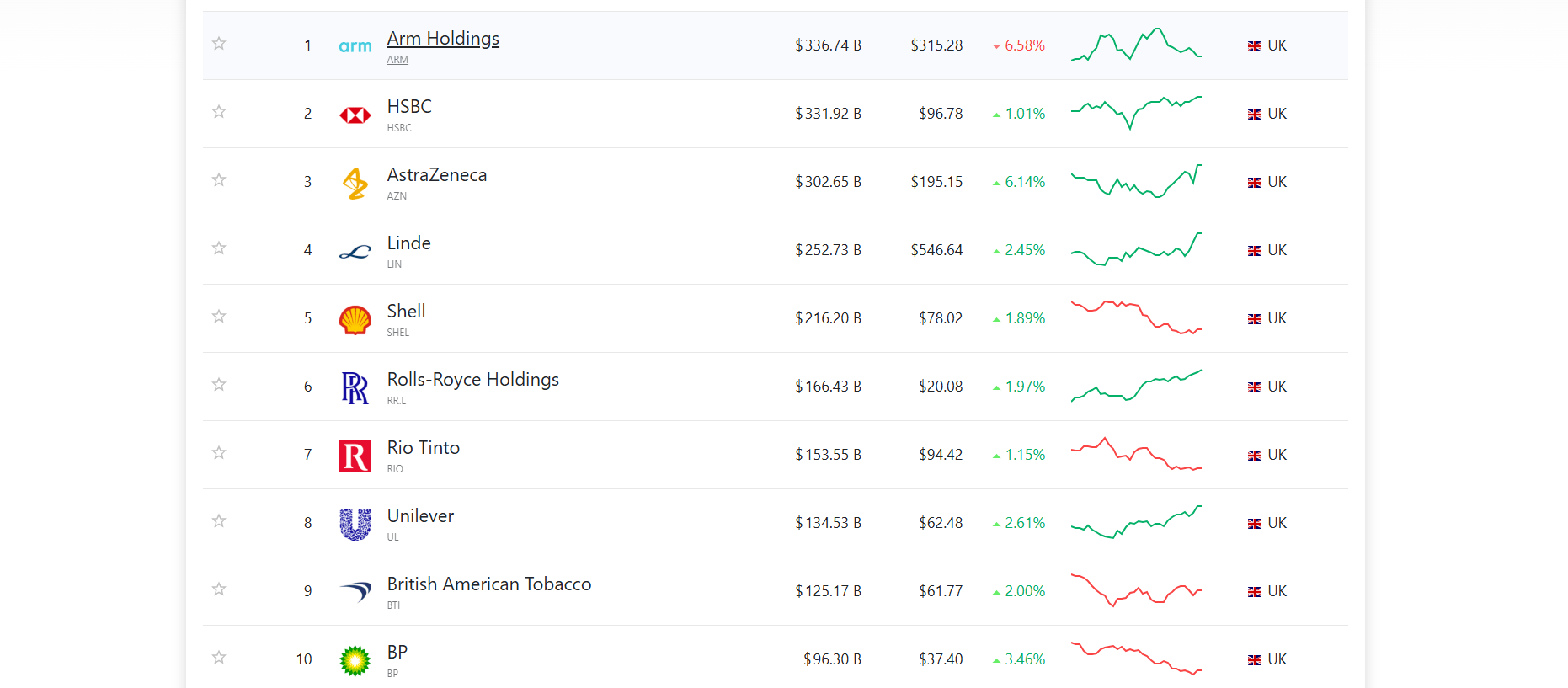
The Current Top 10: UK’s Largest Companies by Market Cap (May 2026)
| Rank | Company | Ticker | Market Cap (USD) | Sector | Share Price | Today’s Change |
|---|---|---|---|---|---|---|
| 1 | Arm Holdings | ARM | $341.77B | Technology / Semiconductors | $321.22 | +4.80% |
| 2 | HSBC | HSBC | $321.49B | Financials / Banking | $93.74 | +1.87% |
| 3 | AstraZeneca | AZN | $290.30B | Healthcare / Pharma | $187.19 | +0.09% |
| 4 | Linde | LIN | $238.09B | Industrials / Industrial Gases | $514.97 | +0.50% |
| 5 | Shell | SHEL | $236.50B | Energy / Oil & Gas | $85.03 | +0.79% |
| 6 | Rio Tinto | RIO | $173.91B | Materials / Mining | $106.94 | +2.60% |
| 7 | Rolls-Royce Holdings | RR.L | $144.79B | Industrials / Aerospace & Defence | $17.45 | +2.93% |
| 8 | British American Tobacco | BTI | $140.43B | Consumer Staples / Tobacco | $64.94 | +0.64% |
| 9 | Unilever | UL | $123.97B | Consumer Staples / FMCG | $57.07 | +0.49% |
| 10 | BP | BP | $109.82B | Energy / Oil & Gas | $42.65 | +3.85% |
Source: companiesmarketcap.com, as of May 2026. Market caps fluctuate daily.
Key Ranking Changes vs. Previous Edition (2025 → 2026)
| Company | Previous Rank (2025) | Current Rank (2026) | Change |
|---|---|---|---|
| Arm Holdings | 5 | 1 | ↑ +4 |
| HSBC | 2 | 2 | → Stable |
| AstraZeneca | 1 | 3 | ↓ -2 |
| Linde | 4 | 4 | → Stable |
| Shell | 3 | 5 | ↓ -2 |
| Rio Tinto | 8 | 6 | ↑ +2 |
| Rolls-Royce Holdings | 7 | 7 | → Stable |
| British American Tobacco | 9 | 8 | ↑ +1 |
| Unilever | 6 | 9 | ↓ -3 |
| BP | 10 | 10 | → Stable |
Key highlights:
- Arm Holdings surges to #1 (was #5): AI chip demand and licensing model scalability drive valuation to the top spot.
- AstraZeneca drops to #3 (was #1): loses the top position it held in 2025; pipeline and patent watch remains key.
- Shell slips to #5 (was #3): energy price moderation and transition investment costs weigh on valuation.
- Rio Tinto climbs to #6 (was #8): resilient iron ore and copper prices alongside disciplined capital allocation.
- British American Tobacco rises to #8 (was #9): high dividend yield continues to attract income investors despite regulatory headwinds.
- Unilever slips to #9 (was #6): margin pressure from input cost inflation and competitive brand dynamics.
- HSBC, Linde, Rolls-Royce Holdings, and BP all held their positions from the previous edition.
- No new entrants or exits – all 10 companies from the 2025 edition retain their places.
Company Profiles: What Each Giant Actually Does
1. Arm Holdings (ARM) — $341.77B

Sector: Technology / Semiconductors | HQ: Cambridge, UK
What they do: Arm designs energy-efficient processor architectures and licenses them to chipmakers worldwide. They don’t manufacture chips themselves — they earn revenue through licensing fees and royalties on every chip sold using their designs.
Why they matter: Arm’s technology powers 99% of smartphones globally, plus growing segments like data centres, IoT devices, and AI accelerators. Their asset-light, royalty-based model offers high margins and scalability.
Key metrics: Revenue $4B annually | No dividend (reinvesting in growth) | P/E ratio elevated due to growth expectations
Beginner note: High-growth, high-volatility stock. Suitable for growth-oriented portfolios with higher risk tolerance.
2. HSBC (HSBC) — $321.49B

Sector: Financials / Banking | HQ: London, UK
What they do: One of the world’s largest banking and financial services organisations, operating in 56 countries. Core businesses: Wealth & Personal Banking, Commercial Banking, and Global Banking & Markets.
Why they matter: HSBC offers unparalleled exposure to Asian growth markets while providing UK investors with a globally diversified financial institution. Strong capital position and consistent dividend history.
Key metrics: Revenue $69B | Dividend yield 4.8% | Serves 39 million customers worldwide
Beginner note: Income-focused holding. Sensitive to interest rates and Asian economic conditions.
3. AstraZeneca (AZN) — $290.30B

Sector: Healthcare / Pharmaceuticals | HQ: Cambridge, UK
What they do: Global biopharmaceutical company focused on oncology, cardiovascular, renal & metabolism, and respiratory & immunology therapies. Invests $6–9B annually in R&D across UK, US, and Sweden.
Why they matter: Leader in innovative drug development with a robust late-stage pipeline. Played a key role in global pandemic response; continues to advance treatments for cancer and chronic diseases.
Key metrics: Revenue $56B | Dividend yield 2.1% | Strong patent-protected portfolio
Beginner note: Defensive growth stock. Less sensitive to economic cycles; watch for clinical trial results and patent expiries.
4. Linde (LIN) — $238.09B

Sector: Industrivals / Industrial Gases | HQ: Guildford, UK (incorporated in Ireland)
What they do: World’s largest industrial gas company, producing and distributing oxygen, nitrogen, hydrogen, helium, and specialty gases. Serves healthcare, electronics, manufacturing, and energy sectors.
Why they matter: Critical infrastructure provider with long-term contracts and recurring revenue. Leading player in the emerging hydrogen economy and clean energy transition.
Key metrics: Revenue $33B | Dividend yield 1.4% | High barriers to entry in gas production/distribution
Beginner note: Stable, defensive industrial play. Less volatile than pure commodity stocks; proxy for global manufacturing health.
5. Shell (SHEL) — $236.50B

Sector: Energy / Oil & Gas | HQ: London, UK
What they do: Integrated energy supermajor active in exploration, production, refining, trading, and marketing of oil, gas, and increasingly renewable energy. Operates in 70+ countries with 40,000+ service stations.
Why they matter: Benefits from vertical integration across the energy value chain. Investing in LNG, renewables, and carbon capture while maintaining strong cash flow from traditional operations.
Key metrics: Revenue $270B | Dividend yield 3.9% | Significant share buyback programme
Beginner note: High-yield cyclical stock. Performance tied to oil/gas prices and energy transition progress.
6. Rio Tinto (RIO) — $173.91B

Sector: Materials / Mining | HQ: London, UK / Melbourne, Australia (dual-listed)
What they do: One of the world’s largest mining corporations, extracting iron ore, copper, aluminium, diamonds, and other minerals. Key supplier to global infrastructure and electrification projects.
Why they matter: Critical provider of “green metals” like copper needed for renewable energy, EVs, and grid infrastructure. Strong balance sheet and disciplined capital allocation.
Key metrics: Revenue $54B | Dividend yield 5.2% | Highly exposed to China demand and commodity cycles
Beginner note: High-yield, high-volatility commodity play. Best held as part of a diversified portfolio; monitor China economic data.
7. Rolls-Royce Holdings (RR.L) — $144.79B

Sector: Industrials / Aerospace & Defence | HQ: London, UK
What they do: Designs, manufactures, and services power systems for aviation (civil and military), marine, and energy applications. Best known for aircraft engines used by airlines and defence forces worldwide.
Why they matter: Unique “power-by-the-hour” servicing model generates recurring revenue from engines already in operation. Continues to benefit from sustained aviation recovery and increased defence spending.
Key metrics: Revenue $24B | Dividend recently reinstated (1.0%) | Order backlog at multi-year highs
Beginner note: Ongoing turnaround with continued recovery potential. Higher volatility; suitable for investors comfortable with industrial cyclicality.
8. British American Tobacco (BTI) — $140.43B

Sector: Consumer Staples / Tobacco | HQ: London, UK
What they do: One of the world’s largest tobacco companies, with 200+ brands including Lucky Strike, Pall Mall, and Viceroy. Rapidly expanding into next-generation products: vapour, heated tobacco, and modern oral nicotine.
Why they matter: Generates strong, predictable cash flow from established brands while investing in reduced-risk alternatives. High dividend yield supported by pricing power.
Key metrics: Revenue $22B | Dividend yield 6.1% | Next-gen products now 25% of revenue
Beginner note: High-yield income stock with regulatory overhang. Suitable for income portfolios; monitor evolving tobacco regulations.
9. Unilever (UL) — $123.97B

Sector: Consumer Staples / FMCG | HQ: London, UK
What they do: Global consumer goods company with 400+ brands across beauty, personal care, home care, and nutrition. Iconic brands include Dove, Hellmann’s, Ben & Jerry’s, and Sunsilk.
Why they matter: Defensive business model with essential products demanded in all economic conditions. Strong emerging market exposure and ongoing portfolio optimisation.
Key metrics: Revenue $58B | Dividend yield 3.5% | Products sold in 190+ countries
Beginner note: Classic defensive holding. Lower growth but reliable cash flow; watch input cost inflation and brand competitiveness.
10. BP (BP) — $109.82B
Sector: Energy / Oil & Gas | HQ: London, UK
What they do: Integrated energy company engaged in oil and gas exploration, production, refining, trading, and increasingly low-carbon energy solutions (wind, hydrogen, EV charging).
Why they matter: One of the world’s “supermajors” with global scale and trading expertise. Balancing traditional energy cash flow with strategic investments in the energy transition.
Key metrics: Revenue $186B | Dividend yield 4.7% | Targeting 50% reduction in oil/gas production by 2030
Beginner note: High-yield energy stock with transition narrative. Volatile but income-generating; monitor oil prices and decarbonisation progress.
Beginner’s Toolkit: Learn as You Invest
A. The “Blue Chip” Advantage: Why Size and Stability Matter
All 10 companies above are classified as “Blue Chip” stocks – a term borrowed from poker, where blue chips hold the highest value.
What defines a Blue Chip?
- Large market capitalisation (typically $10B+)
- Long history of profitability and often dividend payments
- Strong brand recognition and competitive advantages (“moats”)
- Resilience during economic downturns relative to smaller companies – including penny stocks, which are far more volatile and speculative
Why beginners benefit:
- Lower volatility than small-cap or speculative stocks
- Greater analyst coverage and publicly available information
- Easier to research and understand business models
- Often included in major indices, providing natural diversification
Think of Blue Chips as the “foundation layer” of a portfolio – stable, reliable, and designed to preserve capital while generating income.
B. Understanding Dividends: Your Passive Income Engine
Many UK giants are famous for paying dividends – regular cash distributions to shareholders from company profits.
Simple analogy: Think of a dividend as a “thank you” payment from the company to its shareholders. Owning shares is like owning a slice of a profitable business – when it earns money, it shares some of that profit with you.
High-Yield Examples from Our List:
- British American Tobacco: 6.1%
- Rio Tinto: 5.2%
- HSBC: 4.8%
- BP: 4.7%
Important: Dividends are not guaranteed. Companies can cut or suspend them during tough times. Always check the payout ratio (dividends ÷ earnings) to assess sustainability.
C. How to Start Trading UK Stocks
Step 1: Choose the Right Account Type
Step 2: Open a Stocks & Shares ISA
If your goal is to own UK shares directly in a tax-efficient way, a Stocks & Shares ISA is one of the UK’s most powerful investing tools.
Key benefits:
- Tax-free growth: No capital gains tax on profits
- Tax-free income: No income tax on dividends
- Annual allowance: £20,000 per tax year (2025/26)
- Flexibility: Withdraw or reinvest anytime; no lock-in
Step 3: Understand Your Order Types
Beginner recommendation: Start with a Demo account and small limit orders on 1-2 companies you understand. Learn the mechanics before scaling up.
D. Sector Diversification: Don’t Put All Eggs in One Basket
One of the smartest moves a beginner can make is spreading investments across different industries. Sectors don’t move in sync – when energy struggles, healthcare may thrive; when tech corrects, consumer staples may hold steady.
How our Top 10 provide natural diversification:
Simple diversification strategy for beginners:
- Pick 1 company from 3–4 different sectors
- Allocate roughly equal amounts to each
- Rebalance once a year (sell a little of what’s up, buy a little of what’s down)
This reduces the risk that one industry shock (e.g. an oil price crash or a regulatory change) derails your entire portfolio.
Risks to Consider: A Reality Check for New Investors
Even the largest, most stable companies carry risks. Awareness is your best defence.
Market Volatility
Blue Chips aren’t immune. AstraZeneca can drop on clinical trial news; HSBC on China growth concerns; Arm on tech sector rotation. Always invest with a multi-year horizon.
Commodity Price Exposure
Shell, BP, and Rio Tinto are heavily influenced by oil, gas, and metal prices – markets driven by geopolitics, supply chains, and global demand. These can swing wildly. Consider these cyclical holdings, not “set and forget.”
Currency Fluctuations
These companies earn globally but report in GBP. A stronger Pound (£) reduces the value of overseas earnings when converted back. Conversely, a weaker £ can boost reported profits – but may signal broader economic stress. If you’re investing from outside the UK, factor in FX risk.
Regulatory & ESG Pressures
- Tobacco (BAT): Ongoing litigation, advertising restrictions, declining smoking rates
- Energy (Shell/BP): Carbon taxes, net-zero commitments, transition investment costs
- Mining (Rio Tinto): Environmental permits, community relations, tailings dam safety
Interest Rate Sensitivity
- Financials (HSBC) often benefit from higher rates (wider lending margins)
- Growth stocks (Arm) may face valuation pressure when rates rise (future earnings discounted more heavily)
Risk management tip: Never allocate more than 5-10% of your portfolio to a single stock, no matter how “safe” it seems.
Sectoral Deep Dive: Where Are the Opportunities in 2026?
| Sector | Sentiment | Key Catalysts | Watch-Outs | Beginner Takeaway |
|---|---|---|---|---|
| Semiconductors (Arm) | Bullish | AI chip demand, licensing scalability, IoT expansion | High valuations, tech cycle dependency, geopolitical chip restrictions | High-growth, high-volatility. Small position for growth exposure. |
| Banking (HSBC) | Neutral | Rising rates in Asia, wealth management growth, cost-cutting | China property exposure, credit risk, regulatory fines | Income + global diversification. Good for dividend-focused portfolios. |
| Pharma (AstraZeneca) | Bullish | Oncology pipeline, obesity drug potential, emerging market access | Patent cliffs, R&D failure risk, pricing pressure in US/EU | Defensive growth. Core holding for long-term portfolios. |
| Energy (Shell, BP) | Mixed | Energy security demand, share buybacks, renewable investments | Volatile commodity prices, transition execution risk, ESG scrutiny | High yield + cyclical. Use for income, but monitor oil prices. |
| Materials (Rio Tinto) | Cautiously Bullish | Infrastructure spending, copper for electrification, disciplined capex | China demand slowdown, ESG/community conflicts, commodity cycles | Inflation hedge + yield. Pair with defensive sectors. |
| Consumer Staples (Unilever, BAT) | Neutral | Pricing power, emerging market growth, brand loyalty | Input cost inflation, regulatory headwinds (tobacco), brand disruption | Recession-resilient income. BAT offers high yield but higher regulatory risk. |
| Industrials (Rolls-Royce, Linde) | Recovering / Stable | Aviation rebound, defence spending, hydrogen economy investments | Execution risk, high fixed costs, industrial slowdown | Linde is more defensive; Rolls-Royce more cyclical. |
Strategic insight: No single sector wins every year. The goal isn’t to pick the “hottest” sector – it’s to build a balanced portfolio that can adapt. Rebalance annually, stay informed, and align choices with your risk tolerance.
Final Thoughts: Building Confidence, One Step at a Time
The UK’s largest companies offer a compelling blend of stability, income, and global exposure. They may not deliver the 10x returns of early-stage tech startups – but they also rarely go to zero. For beginner investors, that balance is invaluable.
Understanding these companies and the markets they operate in is the first step. The next is putting that knowledge to work.
You can begin trading price movements on all 10 of these companies – and thousands more – through a Hantec Markets account on the MT4 or MT5 platform. Open a free demo account today to practise in a live market environment before committing real capital.
Your action plan:
- Start with education: Understand what you own. Read annual reports. Follow company news.
- Begin small: Trade 1-2 positions on companies you understand. Learn the mechanics.
- Diversify intentionally: Spread across sectors. Avoid overconcentration.
- Think long-term: Let compounding and dividends work. Ignore short-term noise.
- Review regularly: Rebalance once a year. Adjust as your goals evolve.
Investing isn’t about getting rich quick. It’s about building wealth steadily, learning continuously, and gaining control over your financial future.
If you liked this post, you might also want to check out our other articles:
- Top-10 largest non-US companies by market capitalisation
- Top 10 Largest US Companies by Market Capitalisation
- Africa’s Top-10: Leading Companies by Market Capitalisation
- Top 10 Largest Latin American Companies
- Top 10 Largest Companies in China
- Economic Powerhouses: Trillion-Dollar Companies Club
- Titans of the East: The 10 Largest Companies Shaping Asia’s Future
- Top 10 Largest Companies in India
Disclaimer: The content of this article is intended for informational purposes only and should not be considered professional advice.