
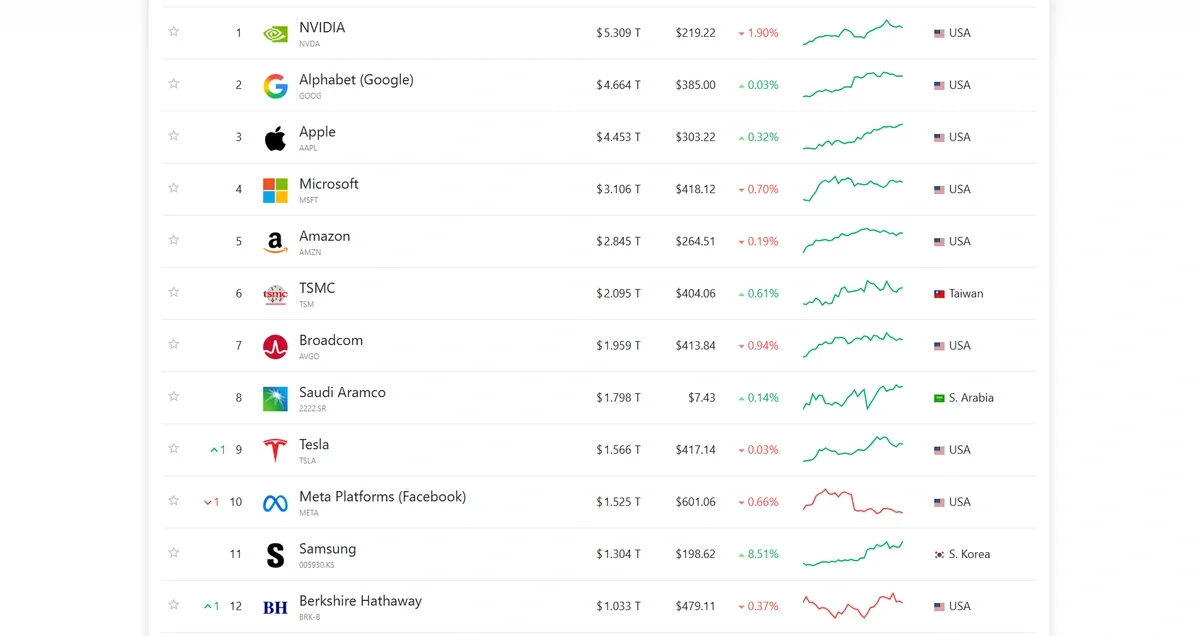
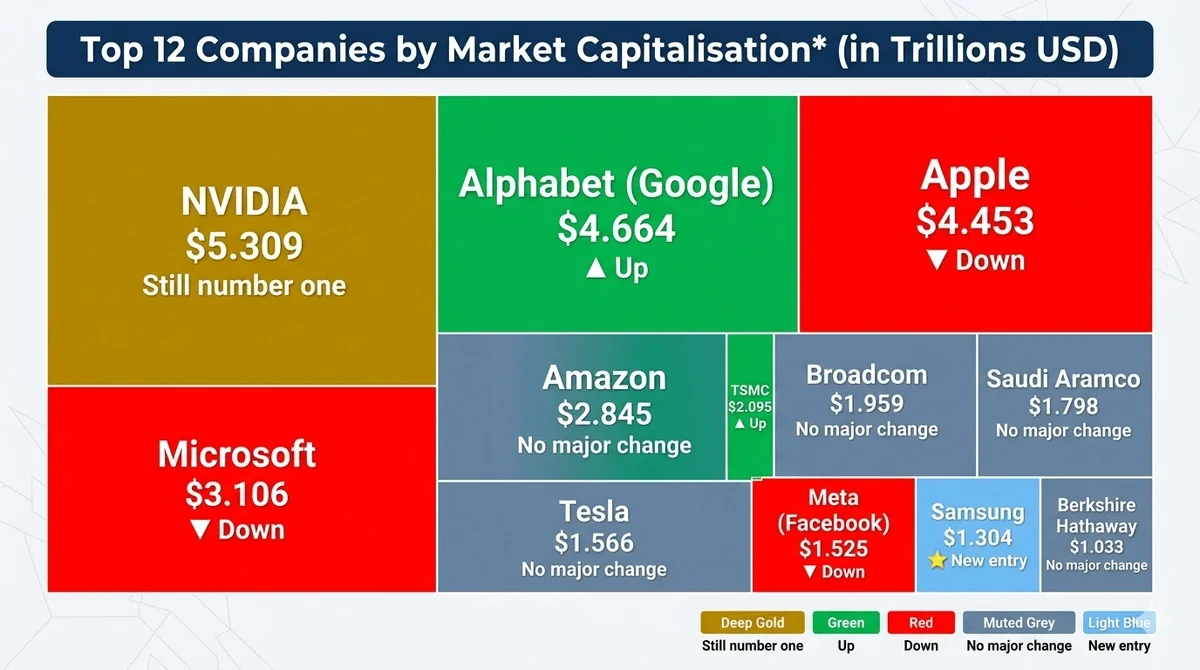
In this post, we explore the largest companies in the world that currently boast a market capitalisation of over $1 trillion. The exclusive club of companies with a market capitalisation exceeding $1 trillion has seen another major reshuffle. Artificial intelligence, semiconductors, cloud computing, energy demand, digital advertising, and retail transformation are all influencing which companies sit at the top of global markets.
Since our last review, Alphabet and TSMC have moved up the rankings, while Samsung and Walmart have entered the trillion-dollar club as newcomers. Microsoft and Meta have moved down in relative position, although both remain firmly above the $1 trillion threshold.
These changes are not just numbers. They show where capital is flowing, which sectors investors are rewarding, and how a small group of mega-cap companies can influence the direction of the broader market.
New Members Join the Party & Overall Changes
The trillion-dollar club has welcomed two new names and seen several major ranking changes.
- Samsung’s AI Memory Surge: Samsung has entered the club as demand for high-bandwidth memory and advanced chips accelerates. AI infrastructure requires enormous memory capacity, and Samsung is one of the world’s most important suppliers.
- Walmart’s near-miss retail milestone: Walmart briefly entered the club, showcasing its massive scale by becoming the first pure-play retailer to touch the $1 trillion mark. While it has since slipped back below the threshold at the moment of publication, its incredible growth across grocery, e-commerce, delivery, logistics, and retail advertising has permanently changed how investors value the business and positions it at the very top of the trillion-dollar watchlist.
- Alphabet Moves Higher: Alphabet has climbed thanks to strong demand for AI tools, Google Cloud, YouTube advertising, and Gemini-powered products.
- TSMC Moves Higher: TSMC has risen as advanced semiconductor manufacturing becomes even more central to AI, smartphones, and data centres.
- Microsoft and Meta Move Lower: Microsoft and Meta remain trillion-dollar companies, but both have slipped in relative ranking as capital has rotated toward other AI and semiconductor leaders.
The Trillion-Dollar Club (As of May 2026)
*According to Companies ranked by Market Cap, as of May 2026. Market capitalisations fluctuate daily.
NVIDIA

Market Cap: $5.309 trillion
Founding Year: 1993
Background: NVIDIA’s journey is a testament to the power of graphics, accelerated computing, and artificial intelligence. Founded by Jensen Huang, Chris Malachowsky, and Curtis Priem, the company began with a focus on graphics processing units (GPUs) for gaming. What started as a gaming hardware business has become the backbone of the global AI boom. NVIDIA’s GPUs now power AI model training, data centres, autonomous vehicle systems, robotics, high-performance computing, and cloud infrastructure. The company became the first company to cross the $5 trillion mark, making it the most valuable company in the world by market capitalisation.
Key Products: Graphics Processing Units (GPUs), Blackwell AI chips, CUDA software, data centre solutions, AI networking systems, and DRIVE autonomous vehicle technology.
Recent Achievements: NVIDIA became the first company to cross the $5 trillion valuation mark. It has also strengthened its position as the global leader in AI infrastructure as demand for advanced chips, data centre networking, and AI computing platforms continues to surge.
Alphabet (Google)
Market Cap: $4.664 trillion
Founding Year: 1998
Background: Alphabet, Google’s parent company, began as a search engine project by Larry Page and Sergey Brin. Google transformed how people access information online and became the dominant force in internet search and digital advertising. Alphabet has since expanded into cloud computing, artificial intelligence, mobile operating systems, video, productivity software, and autonomous driving. Its rise in the latest rankings reflects investor confidence in Google Cloud, YouTube, Gemini AI, and the company’s ability to integrate AI across its core products.
Key Products: Google Search, YouTube, Android, Google Cloud, Gemini AI, Google Workspace, and Waymo.
Recent Achievements: Alphabet moved higher in the trillion-dollar rankings. Its recent momentum has been driven by AI integration across Search, Workspace, and Cloud, continued growth in YouTube monetisation, and increasing enterprise adoption of Google Cloud AI tools.
Apple

Market Cap: $4.453 trillion
Founding Year: 1976
Background: Apple is one of the most influential consumer technology companies in history. Founded by Steve Jobs, Steve Wozniak, and Ronald Wayne, the company helped bring personal computing to the mainstream before reshaping mobile technology with the iPhone. Apple became the first company to reach a $1 trillion market capitalisation on August 2, 2018. Today, its strength comes from a tightly integrated ecosystem of hardware, software, and services that keeps customers engaged across iPhone, Mac, iPad, Apple Watch, AirPods, and subscription products.
Key Products: iPhone, Mac, iPad, Apple Watch, AirPods, App Store, iCloud, Apple Music, Apple TV+, and Apple Intelligence.
Recent Achievements: Apple remains one of the world’s most valuable companies. It continues expanding its high-margin Services business while rolling out Apple Intelligence features across its ecosystem to support future device upgrades and customer retention.
Microsoft
Market Cap: $3.106 trillion
Founding Year: 1975
Background: Microsoft is one of the world’s most important enterprise technology companies. Founded by Bill Gates and Paul Allen, it became a household name through Windows and Office before expanding into cloud computing, gaming, cybersecurity, social networking, and artificial intelligence. Although Microsoft moved down in relative position in this review, it remains a core pillar of the trillion-dollar club. Azure, Microsoft 365, LinkedIn, GitHub, and Copilot continue to make Microsoft central to enterprise digital transformation.
Key Products: Windows, Microsoft 365, Azure, LinkedIn, GitHub, Xbox, Dynamics, Teams, and Copilot AI tools.
Achievements: Microsoft continues to expand AI infrastructure and integrate Copilot across its software products. Azure remains a major growth engine as businesses increase cloud and AI workloads.
Amazon

Market Cap: $2.845 trillion
Founding Year: 1994
Background: Amazon began as an online bookstore founded by Jeff Bezos and became one of the world’s largest technology, logistics, cloud, and retail companies. Its business now spans e-commerce, cloud infrastructure, advertising, streaming, subscriptions, smart devices, and fulfilment networks. Amazon Web Services (AWS) remains one of the company’s most important profit drivers, while retail advertising has become an increasingly important growth area.
Key Products: Amazon.com, Amazon Web Services (AWS), Prime, Amazon Ads, Alexa, Twitch, Audible, and fulfilment services.
Recent Achievements: Amazon continues benefiting from rising AI infrastructure demand through AWS. Its advertising business has also expanded as retail media becomes a larger part of digital advertising budgets.
TSMC (Taiwan Semiconductor Manufacturing Company)
Market Cap: $2.095 trillion
Founding Year: 1987
Background: TSMC pioneered the pure-play semiconductor foundry model. Founded by Morris Chang, the company focuses on manufacturing chips designed by other companies. This model made TSMC indispensable to the global technology supply chain. It manufactures advanced chips for companies including Apple, NVIDIA, AMD, and many others. Its rise in the latest rankings reflects the strategic importance of advanced chip manufacturing in the AI era.
Key Products: Advanced semiconductor manufacturing, AI accelerator chip production, smartphone processors, high-performance computing chips, automotive chips, and advanced packaging services.
Recent Achievements: TSMC moved higher in the trillion-dollar rankings as demand for advanced AI chips continued to rise. The company remains central to global semiconductor supply chains and continues expanding advanced manufacturing capacity.
Broadcom

Market Cap: $1.959 trillion
Founding Year: 1961
Background: Broadcom has grown into a major force in semiconductors, networking hardware, custom silicon, and enterprise infrastructure software. The company traces part of its history to Hewlett-Packard’s semiconductor division and has expanded through both innovation and acquisitions. Broadcom has become increasingly important in the AI infrastructure cycle because data centres require advanced networking chips, custom accelerators, and high-performance connectivity.
Key Products: Custom AI chips, networking and switch silicon, wireless and RF technology, storage connectivity, cybersecurity products, and VMware enterprise software.
Recent Achievements: Broadcom has continued to benefit from demand for AI networking chips and custom silicon. Its VMware integration has also strengthened its enterprise infrastructure software business.
Saudi Aramco

Market Cap: $1.798 trillion
Founding Year: 1933
Background: Saudi Aramco is one of the world’s largest and most profitable energy companies. Its roots go back to oil discoveries in Saudi Arabia in the 1930s, and it remains central to the Kingdom’s economy and global energy markets. While technology dominates much of the trillion-dollar club, Saudi Aramco shows that energy cash flows still matter. Its scale, reserves, and low production costs make it one of the most powerful companies in the global oil industry.
Key Products: Crude oil, natural gas, refining, petrochemicals, energy distribution, and low-carbon energy projects.
Achievements: Saudi Aramco has maintained strong cash flow generation while continuing investments in downstream energy, petrochemicals, hydrogen, and low-carbon technologies.
Tesla (TSLA)
Market Cap: $1.566 trillion
Founding Year: 2003
Background: Tesla began with a mission to accelerate the transition to electric transport. Founded by Martin Eberhard and Marc Tarpenning, and later led by Elon Musk, the company turned electric vehicles from a niche product into a global industry. Tesla’s influence now extends beyond cars. Investors also watch its energy storage business, autonomous driving software, robotics ambitions, and AI development. This is why Tesla often trades more like a technology growth company than a traditional carmaker.
Key Products: Model S, Model 3, Model X, Model Y, Cybertruck, Full Self-Driving software, Powerwall, Megapack, Supercharger network, and robotics initiatives.
Recent Achievements: Tesla remains inside the trillion-dollar club with continued focus on EV production, energy storage, autonomous driving, and AI-related technology. Its share price remains more volatile than many other mega-cap companies.
Facebook (Meta)

Market Cap: $1.525 trillion
Founding Year: 2004
Background: Meta Platforms began as Facebook, a social network created by Mark Zuckerberg and co-founders at Harvard. It later became one of the world’s largest digital advertising companies through Facebook, Instagram, WhatsApp, and Messenger. Meta has moved down in relative ranking, but it remains a powerful trillion-dollar business. Its current growth story is increasingly tied to AI-powered advertising, recommendation systems, content discovery, business messaging, and infrastructure investment.
Key Products: Facebook, Instagram, WhatsApp, Messenger, Reels, Threads, Meta Quest, and Reality Labs products.
Recent Achievements: Meta has continued improving advertising performance through AI tools and expanding Reels monetisation. The company remains focused on balancing AI infrastructure spending with profitability.
Samsung
Market Cap: $1.304 trillion
Founding Year: 1938
Background: Samsung Electronics is one of the world’s largest and most diversified technology companies. It operates across memory chips, smartphones, displays, consumer electronics, and semiconductor manufacturing. Samsung has entered the trillion-dollar club as demand for AI-related memory chips has surged. High-bandwidth memory (HBM), DRAM, and advanced chip technologies are becoming increasingly important as AI data centres require more computing power and memory capacity.
Key Products: HBM memory, DRAM, NAND storage, smartphones, OLED displays, televisions, home appliances, and semiconductor foundry services.
Recent Achievements: Samsung became a newcomer to the trillion-dollar club. Its recent momentum has been supported by AI memory demand, stronger semiconductor pricing, and the growing importance of HBM chips in AI accelerators.
Berkshire Hathaway

Market Cap: $1.033 trillion
Founding Year: 1839
Background: Berkshire Hathaway began as a textile business before becoming one of the world’s most successful conglomerates under Warren Buffett. The company now owns businesses across insurance, railroads, utilities, manufacturing, retail, and consumer sectors. Berkshire is different from most other trillion-dollar companies because it is not built around one technology platform. Its strength comes from disciplined capital allocation, long-term investing, cash-generating businesses, and a diversified portfolio.
Key Products: Insurance through GEICO and reinsurance, BNSF Railway, Berkshire Hathaway Energy, manufacturing businesses, retail subsidiaries, and equity investments.
Recent Achievements: Berkshire Hathaway remains above the trillion-dollar threshold and continues to generate strong operating earnings while maintaining one of the largest cash reserves among major global companies.
Sector Analysis: Where Is Capital Flowing?
The trillion-dollar club shows that capital is flowing most aggressively into AI, semiconductors, cloud computing, and digital infrastructure.
However, the presence of Walmart, Saudi Aramco, Tesla, and Berkshire Hathaway also shows that retail scale, energy cash flows, transport disruption, and disciplined capital allocation still matter.
Technology Still Dominates
Technology remains the largest force in the trillion-dollar club.
AI infrastructure demand has lifted chip designers, chip manufacturers, cloud platforms, and software companies. This explains why NVIDIA, Alphabet, Microsoft, Amazon, TSMC, Broadcom, Meta, and Samsung are central to the current list.
Semiconductors Have Become Strategic Assets
The rise of NVIDIA, TSMC, Broadcom, Samsung, SK Hynix, and Micron shows how important chips and memory have become.
AI models require GPUs, advanced logic chips, networking hardware, and high-bandwidth memory. This has made the semiconductor supply chain one of the most important investment themes in global markets.
Energy Still Matters
Saudi Aramco remains a reminder that the global economy still depends heavily on energy.
Even as renewable energy grows, oil, gas, refining, and petrochemicals continue generating major cash flows.
The Waiting List: Who’s Next?
With Samsung now firmly inside the trillion-dollar club and Walmart returning to the watchlist at the moment of publication, the competition right outside the gates has intensified. The primary companies to watch closely are now:
Walmart – The Near-Miss Retail Milestone
After briefly crossing the $1 trillion mark as the first pure-play retailer to achieve the feat, Walmart has dipped back onto the waiting list. Its unprecedented scale across grocery, e-commerce automation, and retail advertising ensures it remains a prime candidate to reclaim its membership soon.
SK Hynix – The AI Memory Specialist:
SK Hynix is one of the world’s most important suppliers of high-bandwidth memory for AI accelerators. As AI infrastructure spending continues, demand for advanced memory chips could keep SK Hynix close to trillion-dollar territory.
Eli Lilly – The Healthcare Contender:
Eli Lilly is one of the strongest healthcare candidates to approach the trillion-dollar club. Its growth has been driven by demand for diabetes and obesity treatments, especially GLP-1 drugs. This gives healthcare a realistic chance of gaining stronger representation among the world’s most valuable companies.
Micron Technology – The New Name to Watch:
Micron Technology is the new name on the watchlist. The company is benefiting from demand for memory products used in AI servers and data centres. If memory pricing remains strong and AI demand continues, Micron could move closer to the trillion-dollar threshold.
How Trillion-Dollar Companies Emerge
So, how do companies reach a valuation of one trillion dollars? The path usually combines innovation, scale, profitability, market dominance, and investor confidence. These companies do not become valuable by accident. They often control critical products, platforms, or infrastructure that millions of consumers or businesses depend on.
Innovative Technologies: Trillion-dollar companies often lead major technology shifts. NVIDIA leads in AI computing. Apple reshaped mobile devices. Microsoft helped define enterprise software. TSMC became central to advanced chip manufacturing.
Market Dominance: These companies usually dominate their industries. They do not simply participate in markets. They often set standards, influence pricing, shape supply chains, and attract global investor attention.
Global Reach: A trillion-dollar company typically serves customers across multiple regions. Global reach allows these companies to scale revenue, spread brand recognition, and benefit from growth in both developed and emerging markets.
Consistent Growth: Sustainable growth is essential. Investors reward companies that can expand revenue, protect margins, and generate strong cash flows over long periods.
Challenges and the Bigger Picture
Reaching the trillion-dollar mark brings prestige, but it also creates pressure. These companies face regulatory scrutiny, geopolitical risk, antitrust concerns, supply chain pressure, valuation risk, and high investor expectations. A small disappointment in earnings guidance can erase hundreds of billions of dollars in market value.
Their influence also extends beyond financial markets. Trillion-dollar companies shape supply chains, energy policy, AI development, labour markets, data privacy debates, and global innovation. For investors and policymakers, the bigger picture is clear: the performance of these giants will continue to set the tone for markets worldwide.
How This Article Helps a Stock Trader
- Identifies Market Leaders and Trends: The trillion-dollar list shows where investors are concentrating capital. AI, semiconductors, cloud computing, retail technology, and energy are among the most important themes shaping market direction.
- Highlights Potential Breakout Candidates: Companies just below the trillion-dollar threshold can attract attention as they approach the symbolic milestone. SK Hynix, Eli Lilly, and Micron Technology are now the three names to monitor.
- Improves Macro Awareness: The club reflects broader macro themes. Interest rates, AI spending, oil prices, trade policy, semiconductor supply chains, and consumer demand can all affect these companies differently.
- Supports Fundamental and Long-Term Thinking: Beyond short-term trading, the trillion-dollar club highlights companies with deep competitive advantages. Apple’s ecosystem, NVIDIA’s AI infrastructure leadership, TSMC’s manufacturing role, and Walmart’s logistics scale all show how durable business models can support long-term value creation.
The Takeaway: A Changing Landscape
The trillion-dollar club’s reshuffling reflects a global economy increasingly shaped by artificial intelligence, semiconductors, cloud computing, retail scale, energy security, and digital platforms. US companies still dominate, but the presence of TSMC, Samsung, and Saudi Aramco shows that global market leadership is not confined to one country or one sector.
For beginner investors, the most important lesson is that these companies already influence many portfolios through ETFs and index funds. For traders, the key lesson is that these giants can drive market sentiment, sector rotation, and volatility. The world’s largest companies do not simply follow the market anymore. In many cases, they define it.
Disclaimer: Market capitalisations are based on data from CompaniesMarketCap.com as of May 2026 and change daily. This article is for informational purposes only and does not constitute investment advice.
If you are interested in more, check out our articles:
Disclaimer: The content of this article is intended for informational purposes only and should not be considered professional advice.