
What Has Changed Since the Previous Ranking?
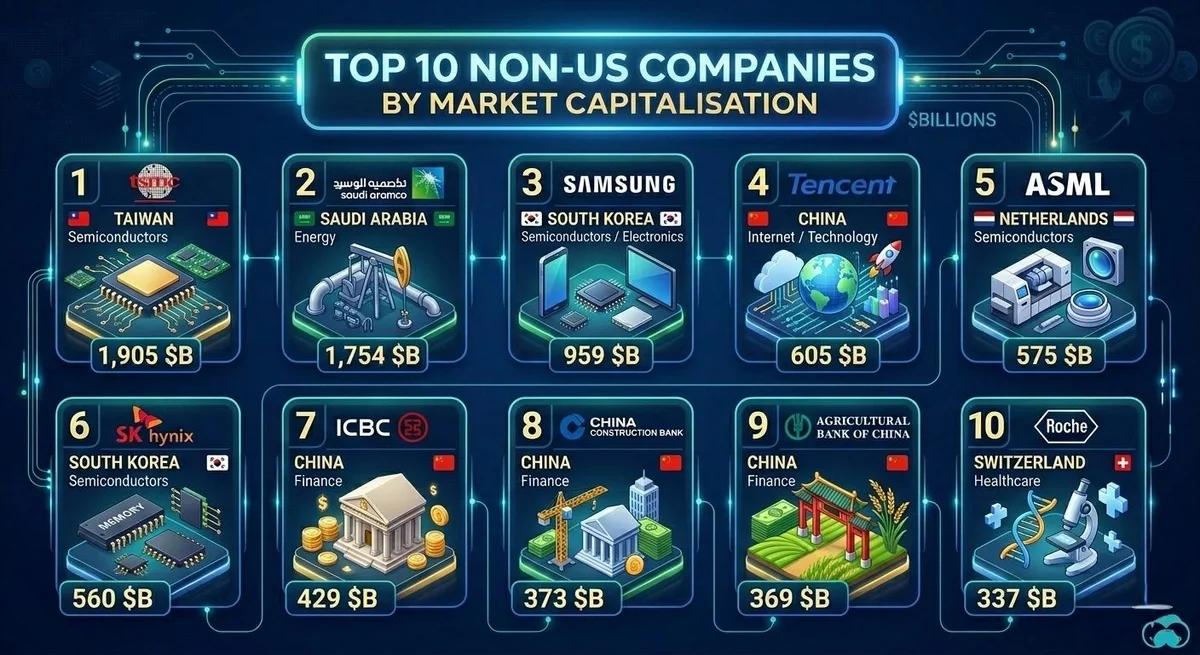
The latest non-US market capitalisation ranking has seen significant shifts driven by the continued rise of AI-related semiconductor demand, the resilience of China’s state-owned banks, and a broad re-rating in the healthcare sector. TSMC has climbed to the top position, displacing Saudi Aramco, becoming the first Asian technology company to lead the non-US ranking. Three companies are entirely new to the top 10: SK Hynix, Agricultural Bank of China, and China Construction Bank. SAP, Novo Nordisk, and Hermès have dropped out of the top 10 but remain important companies to monitor.
Why Market Capitalisation Matters for Traders
Market capitalisation is the total market value of a company’s outstanding shares. For traders, it is more than just a size metric. It reflects investor confidence, affects index weighting in major global benchmarks, and often correlates with liquidity, volatility, and institutional attention.
These companies are not just corporate giants. They are market leaders capable of influencing entire sectors. Earnings, guidance, or strategic announcements from companies like TSMC, Saudi Aramco, or Tencent can move regional indices and shape sentiment across global markets.
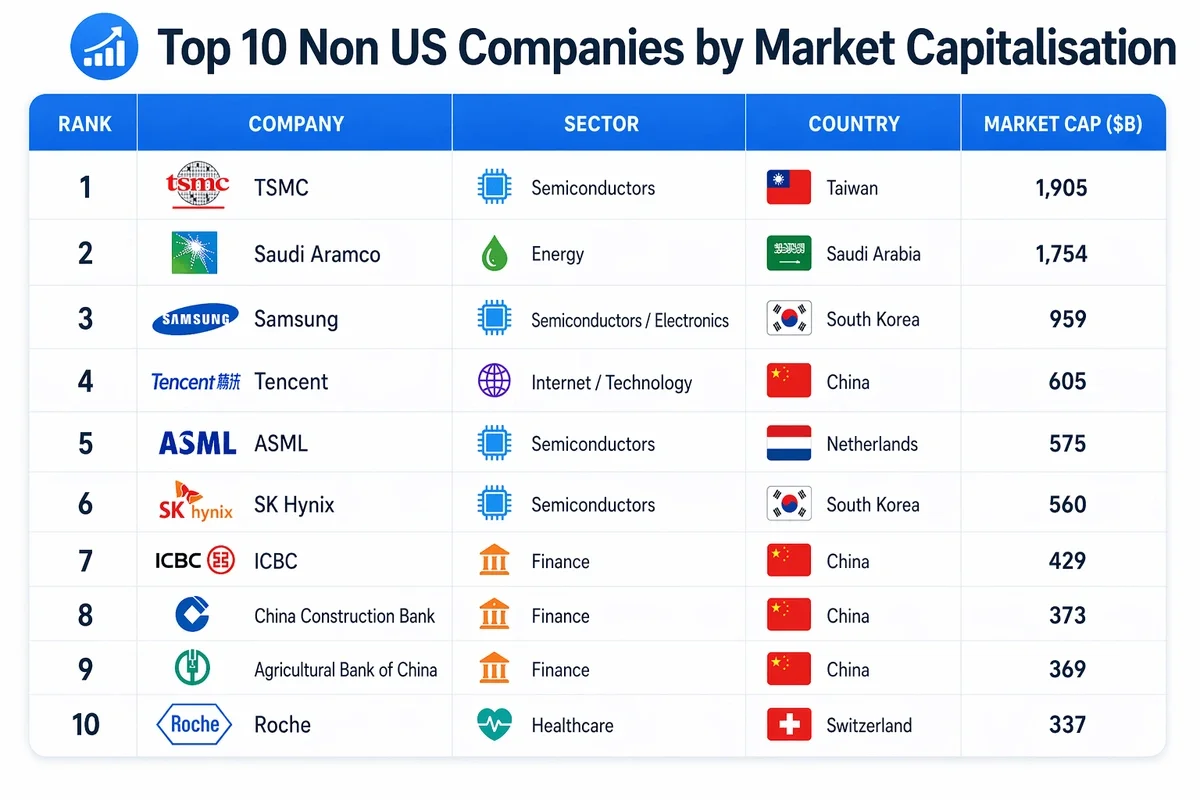
Ten Largest Non-US Companies by Market Capitalisation (2026)
| Rank | Company | Sector | Country | Market Cap ($B) |
|---|---|---|---|---|
| 1 | TSMC | Semiconductors | Taiwan | 1,905 |
| 2 | Saudi Aramco | Energy | Saudi Arabia | 1,754 |
| 3 | Samsung | Semiconductors / Electronics | South Korea | 959 |
| 4 | Tencent | Internet / Technology | China | 605 |
| 5 | ASML | Semiconductors | Netherlands | 575 |
| 6 | SK Hynix | Semiconductors | South Korea | 560 |
| 7 | ICBC | Finance | China | 429 |
| 8 | China Construction Bank | Finance | China | 373 |
| 9 | Agricultural Bank of China | Finance | China | 369 |
| 10 | Roche | Healthcare | Switzerland | 337 |
Source: https://companiesmarketcap.com
1. TSMC (TWSE: 2330, NYSE: TSM)
As a dedicated semiconductor foundry, the company manufactures chips for Apple, NVIDIA, and AMD. Its leadership in advanced node manufacturing, scale, and R&D investments make it difficult to replace.
TSMC is the essential link between chip design and physical production for nearly every major technology company in the world, commanding a near-monopoly on leading-edge fabrication at 3nm and below.
Key business segments:
- Advanced Logic Foundry (3nm and 2nm process nodes for high-performance computing and mobile)
- Advanced Packaging (CoWoS and SoIC for AI server chip integration)
- Specialty Technology (sensors, automotive chips, and display drivers)
Growth drivers:
- AI accelerator chip demand from NVIDIA, AMD, and custom silicon customers
- CoWoS packaging capacity expansion to meet AI server requirements
- Overseas fab expansion in Arizona, Japan, and Germany
Consensus forecasts point to revenue growth of approximately 25% year-over-year next quarter, with high-performance computing now accounting for the majority of TSMC’s revenue mix. Full-year 2026 EPS estimates have been raised, driven by an accelerated AI revenue CAGR in the mid- to high-50% range.
Source: analyst consensus via Yahoo Finance/TrendForce.
2. Saudi Aramco (TADAWUL: 2222)
The world’s largest oil producer, characterized by vertically integrated operations spanning drilling through distribution. Its low production costs, huge reserves, and full control over the oil supply chain create competitive advantages.
Aramco remains the only non-US company other than TSMC to sustain a trillion-dollar valuation, though its position is increasingly subject to oil price volatility and the pace of the global energy transition.
Key business segments:
- Upstream (crude oil and natural gas exploration and production)
- Downstream (refining, petrochemicals, and distribution)
- International ventures including the HAPCO joint venture in China
Growth drivers:
- Downstream petrochemical margin expansion through vertical integration
- Increased natural gas monetisation and LNG development
- Dividend sustainability supported by the world’s lowest production costs
The consensus 12-month price target for Aramco, averaging 28.30 SAR across 18 analysts, implies a modest premium relative to current levels, with 8 analysts recommending buy and 10 recommending hold. Analysts note that OPEC+ production discipline and downstream integration through HAPCO provide partial insulation against crude price swings.
Source: MarketScreener / NAGA.
3. Samsung Electronics Co., Ltd. (KRX: 005930)
The South Korean firm leads in memory chips and display technology, with vertical integration across hardware, components, and displays enabling supply chain control.
Samsung’s unique position spans both semiconductor manufacturing and consumer electronics, giving it unmatched exposure to demand cycles across multiple technology segments simultaneously.
Key business segments:
- Semiconductor (DRAM, NAND flash, and logic foundry)
- Mobile Experience (smartphones, wearables, and the Galaxy ecosystem)
- Display Panels (OLED and QD-OLED for mobile and television)
- Consumer Electronics (home appliances and televisions)
Growth drivers:
- DRAM and NAND pricing recovery driven by AI data centre demand
- High Bandwidth Memory (HBM) ramp to compete in the AI accelerator supply chain
- Premium Galaxy device cycle and foldable smartphone expansion
Brokerages have sharply raised 2026 earnings forecasts for Samsung, citing steep increases in DRAM and NAND pricing alongside accelerating demand from AI server deployments. Samsung’s HBM progress remains closely watched as a key variable for the next quarter.
Source: Digitimes / DigitalToday.
4. Tencent Holdings Ltd. (SEHK: 0700)

This Chinese tech giant operates WeChat and dominates mobile gaming globally. Its interconnected platform where users can chat, play, shop, and pay generates diverse revenue streams.
Tencent’s ability to monetise its billion-plus user base across gaming, advertising, and financial services through a single integrated ecosystem gives it structural advantages that are difficult to replicate outside China.
Key business segments:
- Value-Added Services (mobile and PC gaming, social network subscriptions)
- Online Advertising (WeChat Moments and Mini Program advertising)
- FinTech and Business Services (WeChat Pay, cloud computing, and enterprise software)
Growth drivers:
- AI integration in gaming engagement and advertising targeting
- Cloud and enterprise software demand from domestic corporates
- International gaming expansion and overseas IP monetisation
Tencent reported full-year 2025 revenue slightly ahead of consensus estimates, and analysts expect value-added services including gaming to grow at approximately 11% year-over-year next quarter. AI investments in HunYuan and Yuanbao are expected to more than double in 2026, funded by core business earnings. Analyst consensus carries a buy rating with a target implying approximately 30% upside.
Source: MarketBeat / Invezz.
5. ASML Holding N.V (NASDAQ: ASML)
This Dutch company holds a near-monopoly on EUV lithography, creating extreme barriers to entry in semiconductor manufacturing equipment.
ASML is the only company in the world capable of manufacturing extreme ultraviolet lithography machines, making it an unavoidable part of the supply chain for every advanced chip fabricator on the planet.
Key business segments:
- EUV Systems (extreme ultraviolet lithography for 5nm and below)
- Deep UV Systems (immersion and dry lithography for mature process nodes)
- Applications and Services (software, refurbishment, and field support)
Growth drivers:
- Capital expenditure cycles at TSMC, Samsung, and SK Hynix
- High-NA EUV adoption anticipated in 2027-28 by leading foundries
- Installed base management and system upgrade revenue
2026 revenue growth is expected to be modest at approximately 5%, as strong logic and memory capex from TSMC, Samsung, Micron, and SK Hynix partially offsets a significant decline in China sales due to export restrictions. New system bookings remain the key investor focus. Morningstar notes that TSMC fab expansions and memory shortages underpin the long-term investment case.
Source: Seeking Alpha / Morningstar / Sourceability.
6. SK Hynix (KRX: 000660, FWB: HY9H)

SK Hynix is South Korea’s second largest semiconductor company and the world’s leading producer of High Bandwidth Memory (HBM), the specialised chip architecture that sits directly inside AI accelerator systems. Its dominant position in HBM has driven a significant re-rating of its valuation.
SK Hynix supplies the memory components that enable AI processors to handle massive data throughput in data centre servers, making it a critical and often underappreciated link in the global AI infrastructure chain.
Key business segments:
- DRAM (standard and HBM variants for server, mobile, and PC applications)
- NAND Flash (enterprise solid-state drives and consumer storage)
- High Bandwidth Memory (HBM3E and HBM4 for AI accelerators)
Growth drivers:
- HBM3E and HBM4 demand from NVIDIA’s next-generation GPU platforms
- HBM capacity fully booked through 2026, supporting pricing power
- Broader DRAM and NAND pricing recovery driven by AI server demand
Morgan Stanley raised 2026 and 2027 earnings forecasts for SK Hynix by 56% and 63% respectively, citing stronger memory pricing assumptions. Goldman Sachs estimates SK Hynix will maintain over 50% HBM market share through 2026, with UBS forecasting approximately 70% share in the HBM4 market for NVIDIA’s Rubin platform. Bank of America estimates the total HBM market will reach $54.6 billion in 2026, a 58% increase year-over-year.
Source: SK Hynix News / TrendForce / Investing.com.
7. ICBC (SSE: 601398, HKEX: 1398)

China’s largest bank by assets supports infrastructure and commerce domestically and internationally, with government backing providing stability.
ICBC’s scale, sovereign backing, and central role in financing China’s public and private sector make it one of the most systemically important financial institutions in the world, despite operating in a lower-growth domestic environment.
Key business segments:
- Corporate Banking (infrastructure loans and project finance)
- Retail Banking (deposits, mortgages, and personal lending)
- Treasury and Institutional (bond investments and interbank markets)
- International Operations (global branches and correspondent banking)
Growth drivers:
- Government infrastructure stimulus and policy-directed lending
- Retail deposit base supporting low-cost funding advantage
- Belt and Road project financing in international markets
Analysts expect ICBC’s net interest income to face moderate pressure from declining lending rates in 2026, consistent with broader Chinese banking sector dynamics. However, stable asset quality and government-backed lending mandates are expected to support earnings resilience in the near term.
Source: Morningstar / Motley Fool.
8. China Construction Bank (SSE: 601939, HKEX: 0939)

China Construction Bank (CCB) is one of China’s “Big Four” state-owned banks and the country’s largest mortgage lender. It plays a central role in financing domestic infrastructure, real estate, and urban development.
CCB’s dominant position in infrastructure and property lending makes it a direct proxy for China’s construction and urban development cycle, while its scale and government backing provide financial stability through periods of sector stress.
Key business segments:
- Personal Banking (mortgages, wealth management, and deposits)
- Corporate Banking (infrastructure, construction, and project finance)
- Treasury (liquidity management and fixed income)
- International Business
Growth drivers:
- Government-led infrastructure stimulus and construction projects
- Green finance and low-carbon infrastructure lending
- Wealth management fee income expansion
Analysts expect CCB to maintain stable earnings next quarter, with infrastructure-linked loan growth partially offsetting continued pressure from the domestic property sector. The bank’s growing focus on green finance is increasingly cited by sell-side analysts as a long-term structural differentiator.
Source: companiesmarketcap.com / CNBC.
9. Agricultural Bank of China (SSE: 601288, HKEX: 1288)
Agricultural Bank of China (AgBank) is one of the country’s “Big Four” state-owned banks and the institution with the largest rural banking network in the world. It serves over 700 million customers and plays a central role in China’s agricultural economy and rural revitalisation strategy.
AgBank’s unmatched penetration of China’s rural and lower-tier markets gives it a structural funding advantage through low-cost retail deposits, alongside a politically important role that reinforces its access to government-directed lending programmes.
Key business segments:
- Retail Banking (rural deposits, personal loans, and payment services)
- Corporate Banking (agribusiness financing and rural infrastructure lending)
- Treasury (bond portfolio management and liquidity operations)
- International Operations
Growth drivers:
- Chinese government rural revitalisation and agricultural modernisation policy
- Digital banking expansion into underserved rural regions
- Infrastructure and green finance lending growth
Analysts expect steady loan growth for AgBank next quarter, supported by continued government-directed lending to agriculture-related sectors and rural infrastructure projects. Net interest margins are expected to face mild compression consistent with the broader Chinese banking sector, though the bank’s low-cost deposit base provides relative insulation.
Source: companiesmarketcap.com / Yahoo Finance.
10. Roche (SIX: ROP, FWB: RHO)

Roche is one of the world’s largest healthcare companies, with leading positions in both oncology pharmaceuticals and in vitro diagnostics. Its dual-division structure provides revenue diversification that few global peers can match.
Roche’s integrated approach, developing both the drugs and the diagnostic tests that identify patients who benefit from them, creates a self-reinforcing commercial model with strong pricing power in specialised therapeutic areas.
Key business segments:
- Pharmaceuticals (oncology, neuroscience, and immunology)
- Diagnostics (clinical chemistry, molecular diagnostics, and pathology)
- Personalised Healthcare (companion diagnostics and data platforms)
Growth drivers:
- Next-generation oncology pipeline assets in late-stage clinical trials
- Diagnostics division recovery as global hospital volumes normalise
- Neuroscience expansion in Alzheimer’s disease and neurological disorders
Roche reported 7% sales growth for full-year 2025 and has guided for mid-single-digit sales growth in 2026, with core EPS targeted to grow in the high-single-digit range. Analysts expect oncology and diagnostics to remain the primary growth contributors next quarter, with the neuroscience pipeline providing potential upside catalysts.
Source: Roche Investor Relations (January 2026).
Just Outside the Top 10: Three More to Watch
While they are no longer in the top 10, these companies remain highly relevant for traders focused on global markets.
11. PetroChina – Market Cap: $343 Billion | Energy
PetroChina is one of the world’s largest oil and gas producers and China’s dominant state-owned energy company. Its operations span upstream production, midstream pipelines, and downstream refining and petrochemicals.
Analysts expect next quarter results to be driven by upstream production volumes, with crude oil price movements remaining the key swing factor. PetroChina’s new high-complexity refinery assets, including the Dalian complex, are expected to provide increasing exposure to higher-margin petrochemical products.
Source: StocksGuide / Fintel.
12. Alibaba – Market Cap: $293 Billion | E-commerce & Cloud | Previously in Top 10
Operating China’s major e-commerce platforms and Alipay, its integrated model—from search to payment to logistics—enables high operating efficiency.
Alibaba’s Cloud Intelligence Group grew 34% year-over-year in the most recent quarter, and analysts expect continued momentum in AI-related cloud services. E-commerce revenue is expected to grow in the mid-single-digit range, with improving margins from ongoing cost discipline. AI infrastructure investments are increasingly viewed as the primary long-term value driver.
Source: IG International / Seeking Alpha.
13. Novartis – Market Cap: $286 Billion | Pharmaceuticals
Novartis is a leading Swiss pharmaceutical company with a focused portfolio in oncology, cardiovascular disease, and immunology. It divested its generics subsidiary Sandoz in 2023 to concentrate fully on innovative branded medicines.
Novartis has guided for low-single-digit net sales growth in 2026, reflecting the company’s largest patent-expiry period on record. Analysts expect new product launches in oncology and immunology to partially offset generic erosion headwinds, with the company’s 5-6% sales CAGR target for 2025-2030 underpinning a positive long-term view.
Source: Novartis Investor Relations / MarketBeat.
Key Trends from the Top 13
Asian Dominance
The list is heavily dominated by Asian firms, particularly from China (six companies), South Korea (two), and Taiwan (one). This reflects the region’s massive industrial scale across finance, technology, and energy, and reinforces Asia’s growing weight in global equity markets.
The AI and Chip Engine
Three of the top six companies – TSMC, ASML, and SK Hynix—are critical pillars of the global semiconductor supply chain. Their high valuations are driven by the explosive growth of artificial intelligence and high-performance computing, where they hold near-monopoly positions in production and equipment. This cluster of companies represents one of the most concentrated sources of AI infrastructure exposure outside the United States.
Financial Fortresses
China’s “Big Four” banks – ICBC, Agricultural Bank of China, and China Construction Bank—remain among the most valuable non-US financial entities. Despite slower domestic growth and net interest margin pressure, their sheer asset size, government backing, and role in the global economy keep them entrenched near the top of the ranking.
Energy Giants
Saudi Aramco and PetroChina represent the enduring value of traditional energy. Aramco remains the only non-US company besides TSMC to maintain a trillion-dollar valuation, though it faces increasing competition for the top global spot from US technology giants like NVIDIA and Apple. PetroChina’s position reflects China’s continued reliance on domestic fossil fuel production to support energy security.
European Stalwarts
Europe’s presence in this top tier is primarily through safe-haven sectors: healthcare through Roche and Novartis in Switzerland, and specialised technology through ASML in the Netherlands. Notably, the ultra-luxury sector, LVMH, Hermès, has recently fluctuated just outside this top 13, reflecting shifts in global consumer spending and Chinese luxury demand.
Sector Distribution
| Sector | Companies |
|---|---|
| Technology / Semiconductors | 4 (TSMC, Samsung, ASML, SK Hynix) |
| Finance / Banking | 3 (ICBC, Agricultural Bank of China, China Construction Bank) |
| Energy | 2 (Saudi Aramco, PetroChina) |
| Healthcare / Pharma | 2 (Roche, Novartis) |
| Internet / E-commerce | 2 (Tencent, Alibaba) |
Final Thoughts for Traders
The non-US market capitalisation ranking is more than a list. It is a snapshot of where global capital is flowing, and which themes are dominating international equity markets.
At present, the most powerful forces are clear: AI-driven semiconductor demand is reshaping valuations at the very top of the list, China’s state-backed financial system continues to generate enormous balance sheet scale, and energy remains a reliable source of value in an uncertain macro environment.
For traders, these companies are essential to monitor not only for individual stock opportunities, but also for broader signals about sector rotation, regional risk appetite, and global growth expectations. Understanding who leads this list and why can offer valuable insight into the forces currently shaping international markets.
If you liked this post, you might also want to check out our other articles:
- Top 10 Largest US Companies by Market Capitalisation
- 10 Biggest UK-based Companies
- Africa’s Top-10: Leading Companies by Market Capitalisation
- Top 10 Largest Latin American Companies
- Top 10 Largest Companies in China
- Economic Powerhouses: Trillion-Dollar Companies Club
- Titans of the East: The 10 Largest Companies Shaping Asia’s Future in 2025
- Top 10 Largest Companies in India
Disclaimer: The content of this article is intended for informational purposes only and should not be considered professional advice.