
Silver sits in a rare category of assets. It is a precious metal, an industrial input, and a trader’s favourite volatility play all at once. That combination makes it unusually sensitive to war risk, inflation, the U.S. dollar, Federal Reserve policy, and shifts in risk sentiment. In early 2026, those forces collided hard, and silver responded with some of the largest price swings ever seen in the market, including a surge to an all-time high around $121.62 on 29 January, followed by a historic sell-off soon after.
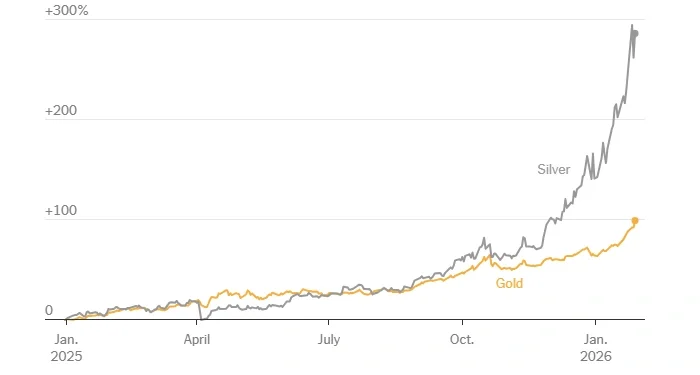
Silver and gold price performance. Source: FactSet. By The New York Times
In this guide, we will explore:
- what the USA–Israel–Iran conflict means for silver in the long run,
- what really drove the January silver price spike,
- why silver is more volatile than gold,
- how XAG/USD works in Forex,
- the most useful silver trading strategies,
- and the biggest risks traders need to respect.
Table of Contents
- US-Israel-Iran war & its effect on Silver (XAG)
- The January Silver price spike
- What makes Silver (XAG) so volatile [+ exciting to trade]
- How to trade Silver (XAG) in Forex
- Silver (XAG) trading strategies
- Risks of trading Silver in this market
- Is Silver (XAG) the next big opportunity?
How the USA–Israel–Iran Conflict Is Reshaping Silver’s Long-Term Outlook
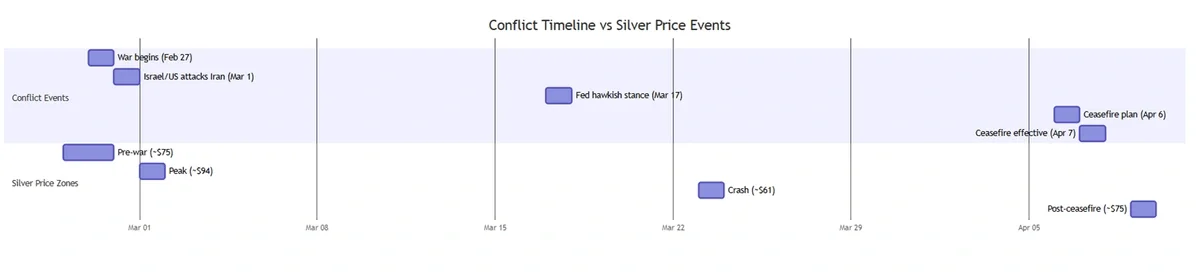
The geopolitical backdrop matters because silver is not driven by one theme alone. It can rise when investors want safety, and it can also rise when industrial demand is strong. In periods of conflict, the haven bid often appears first. That is exactly what recent market analysis has shown: tensions involving Iran, the Russia–Ukraine conflict, and wider Middle East uncertainty have supported demand for precious metals because investors tend to move away from riskier assets when war risk rises.
The long-term case for silver becomes stronger when several forces line up together:
- war and geopolitical risk increase safe-haven buying,
- inflation and currency weakness raise demand for hard assets,
- industrial demand remains strong from solar, electronics, semiconductors, EVs, and data centres,
- and physical supply stays tight.
That is an important combination. Silver is not just “the poor man’s gold.” It is a metal with a growing industrial role. BlackRock notes that about 60% of annual silver consumption is linked to electronics, solar panels, and semiconductors, while the buildout of data centres and AI workloads adds a growth-sensitive demand layer. Indicators also pointed to a sixth consecutive annual supply deficit and tight COMEX inventory coverage as part of the bull case for silver.

So, what does the geopolitical climate mean in the long run? It means silver may keep attracting a strategic premium. If conflict risk stays elevated, silver can keep benefiting from safe-haven flows. If war risk eases, the metal may remain well supported by structural deficits and industrial demand. That makes silver a market where the long-term story is not just about headlines. It is about a slow tightening of fundamentals underneath a very noisy price.
January’s Silver Price Spike: The Rally, the Trigger, and the Brutal Reversal
January 2026 was one of those months that changed how many traders looked at silver. The metal did not simply rally. It exploded. Silver moved from the low $30s at the start of the year to an all-time high around $121.62 by 29 January, according to Investing News, before suffering a major collapse immediately after. Reuters later described the reversal as historic, noting that silver fell as much as 30% in a single day during the unwind.
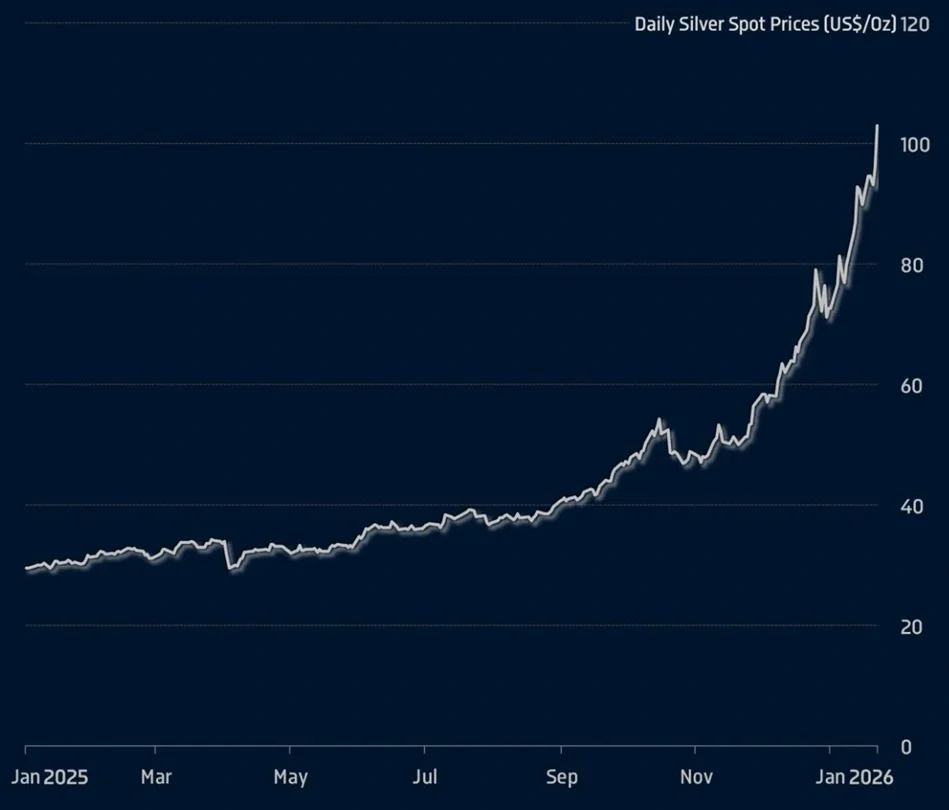
What happened? The rally turned into a price-discovery event. Silver was suddenly behaving less like a calm precious metal and more like a momentum asset caught in a squeeze. The move was driven by a mix of speculative buying, safe-haven demand, and fear around currency debasement. Reuters reported that silver had already risen 70% in the first four weeks of the year, with traders increasingly worried about fiscal excess, expanding money supply, and a degraded currency.
How much did silver move? The scale was extreme:
| Market Event | Details |
|---|---|
| Early Year Position | Silver climbed from roughly the low $30s |
| All-Time High (29 Jan) | Reached around $121.62 |
| Reversal (30 Jan) | Plunge of over 31% to around $78.53 |
| Historical Impact | One of the largest one-day losses on record in the crash |
That is not normal silver behaviour. That is a market under stress, with leverage, momentum, and fear all working at once.
What caused the spike? It was not one single reason. It was a stack of them:
- USD weakness: A softer dollar usually supports silver because silver is priced in dollars. When the dollar weakens, non-U.S. buyers can purchase the metal more cheaply, and that can add demand.
- Inflation fears: Precious metals often benefit when investors worry that inflation is eroding purchasing power. Reuters noted that the rally was partly rooted in fear of fiscal folly and currency debasement.
- Geopolitical risk: War risk in the Middle East amplified safe-haven flows. Investors often buy precious metals during periods of conflict because they want exposure to assets outside the direct credit system. In early 2026, that dynamic was clearly visible in silver as well as gold.
- Industrial demand: Silver’s industrial profile mattered too. The market was already supported by structural demand from electronics, solar, and other applications. That does not create a 300% spike by itself, but it does provide a strong background bid when speculative flows appear.
The key lesson is that the January spike was not random. It was the result of macro fear, war anxiety, physical tightness, and crowded speculative positioning colliding all at once. That is why the move was so violent in both directions.
Why Silver is so Volatile & Shiny to Traders
Silver is one of the most exciting, and most dangerous, markets to trade. Its volatility is not a side effect. It is the main feature.
Silver vs Gold comparison
Gold is the classic haven. Silver is the wild card. BlackRock notes that silver’s annualised volatility has been up to twice that of gold over the past 20 years, while the World Gold Council says silver’s volatility is roughly twice gold’s and that wider spreads contribute to the effect. Morgan Stanley goes even further, saying silver’s volatility can be two to three times greater than gold’s on a given day. That gap exists because silver is smaller, thinner, and more reactive. Gold is huge, deep, and heavily held by institutions and central banks. Silver is smaller and more vulnerable to abrupt flows. When a large order hits silver, it can move the price far more than the same order would move gold.
Industrial demand impact
Silver also behaves differently because of what it is used for. More than half of silver demand comes from heavy industry and high technology, including smartphones, solar-panel cells, automobile electrical systems, and other applications. BlackRock similarly notes that around 60% of annual silver consumption is tied to electronics, solar panels, and semiconductors, with AI and data-centre demand adding another growth-sensitive layer.
That matters because silver now has two identities:
- a monetary asset when markets are fearful,
- and an industrial metal when the economy is expanding.
This dual role creates volatility. When growth is strong, industrial demand can lift silver. When growth weakens, that same industrial sensitivity can drag it down. Gold does not have that problem to the same extent. Gold mostly responds to rates, the dollar, and fear. Silver responds to those things plus the real economy.
Higher volatility than gold
This is why traders love silver. It can move faster than gold, and often harder. It was pointed out that silver has outperformed gold over the past year with a roughly 150% gain versus gold’s roughly 56%, while still carrying much greater volatility and a more severe downside case if conditions turn. That is exactly why silver attracts short-term traders: it offers bigger swings, sharper breakouts, and stronger momentum potential.
How silver reacts to key market drivers
- Inflation: Silver can rise on inflation fears because traders may look for hard assets. But if inflation pushes the Fed to stay hawkish, that can cap gains or reverse the move.
- Dollar strength: A stronger U.S. dollar usually weighs on silver. Hawkish Fed signals can keep the dollar firm, increase the opportunity cost of holding silver, and make the metal more expensive for foreign buyers.
- Federal decisions: Silver is extremely sensitive to rate expectations. Dovish signals can support silver because real yields may fall and the dollar may weaken. Hawkish surprises can crush it. Reuters showed this clearly when precious metals plunged after hawkish Fed expectations shocked the market in early February 2026.
- Risk sentiment: Silver often rises in risk-off environments because investors seek safety. But if risk-off shifts into recession fear, industrial demand expectations may weaken and silver can fall anyway. That makes it less straightforward than gold.
Why traders find silver attractive
Silver’s volatility creates opportunity:
- it can trend strongly,
- it can break out sharply,
- it can react to macro headlines instantly,
- and it can outperform gold in bullish precious-metals cycles.
But that same volatility means silver punishes overconfidence. It is exciting because it moves. It is dangerous because it moves so much.
XAG/USD Explained: How to Trade Silver in Forex Like a Pro
In Forex, silver is usually traded as XAG/USD, which is the price of one troy ounce of silver quoted in U.S. dollars. It is traded as a CFD or similar instrument, so traders speculate on price movement rather than taking delivery of metal.
How to Start Trading Silver in 4 Quick Steps
- Choose a broker
- Select instrument (XAG/USD, ETF, futures)
- Analyse market (technical + fundamental)
- Place trade with risk management
What affects XAG price?
The main drivers are:
- U.S. interest rate expectations,
- dollar strength,
- geopolitical risk,
- inflation data,
- gold price trends,
- industrial demand,
- and physical supply tightness.
Trading sessions
Silver trades nearly 24 hours a day, five days a week. The most active periods are usually the London and New York sessions, especially when they overlap. That is when liquidity improves and the biggest moves often occur.
Typical volatility
Silver can move much more than standard currency pairs. A 1% to 3% move in a day is not unusual. During major news events, it can move far more. That is why traders need wider stops and smaller position sizes than they might use on a calmer pair.
Spreads and leverage
Broker spreads on XAG/USD vary. Interactive Brokers offers a very tight XAG/USD CFD spread relative to market averages, though overnight financing still matters. Leverage is a double-edged sword. It allows traders to control a large notional position with relatively little capital, but it also magnifies losses quickly.
A simple example
| Trade Scenario | P&L Result |
|---|---|
| Buy 100 ounces at $75, rises to $80 | $500 gain |
| Buy 100 ounces at $75, falls to $70 | $500 loss |
| Note: With leverage, these moves become huge relative to margin. Position sizing matters more in silver than in other markets. | |
Silver Trading Strategies: Breakouts, News & Trends
Silver rewards traders who respect momentum and context. The best strategies are usually simple, but they need discipline.
Breakout strategy
This is one of the most effective approaches for silver because the metal is prone to sharp expansion moves. When price compresses around a major level and then breaks out, the follow-through can be strong. Useful breakout tactics include:
- trading above a recent high after confirmation,
- using buy-stop or sell-stop orders,
- and waiting for momentum to close above resistance before entering.
If silver clears the 50 EMA around $78 and then the $94 area, the path can reopen toward the late-January highs near $120. That is the kind of structure breakout traders watch for.
News trading
Silver responds quickly to data releases and geopolitical headlines. Fed meetings, CPI prints, jobs reports, war headlines, ceasefire talks, and supply-shock news can all trigger major moves. A good news trader usually:
- knows the event time,
- has a clear bias or no bias at all,
- uses smaller size,
- and expects slippage.
This style can work very well in silver, but only if the trader accepts that the first move is not always the real move.
Trend-following
When the macro backdrop is clear, silver can trend for a long time. Trend traders try to align with the dominant direction rather than predict every swing. A trend-following framework may include:
- moving averages,
- momentum indicators,
- higher-high / higher-low structure,
- and pullback entries into the trend.
This works best when the dollar is weakening, the Fed is turning more dovish, inflation remains sticky, and geopolitical risk stays elevated.
Support and resistance
Silver respects chart memory. Previous highs, lows, and round numbers often become reaction zones. That makes support and resistance useful for timing entries and exits. A practical approach:
- buy near support when momentum stabilises,
- sell near resistance when rallies stall,
- and use confirmation from volume or rejection candles.
Because silver is so volatile, these levels matter more than they would in a calmer market. They often become decision points where big orders cluster.
Why Is Silver So Volatile? (Compared to Gold)
Silver often follows gold, especially during precious-metals rallies. Silver tends to follow gold’s moves and that the gold/silver ratio can help traders judge relative value between the two metals. That gives traders three useful signals:
- if gold breaks out and the dollar weakens, silver often has room to rise,
- if gold rises but the dollar strengthens, silver may lag,
- if the gold/silver ratio becomes extreme, silver may look undervalued versus gold.
Correlation trading is not a guarantee, but it gives context. In silver, context matters.
Risks of Trading Silver: Volatility, Slippage, and Over-Leverage
Silver is attractive, but the risks are real and severe, since the world is moving into a new tangent that affects every touchpoint across all sectors in motion.
- High volatility: This is the biggest risk. Silver can move fast enough to turn a good idea into a bad trade in minutes. Reuters reported one of the largest one-day collapses in precious metals history after the January spike, with silver down as much as 30% in the crash. That kind of move can destroy poorly sized positions.
- Slippage during news: When major data or geopolitical headlines hit, fills may be worse than expected. Stops can slip. Spreads can widen. Liquidity can disappear. The trader sees the chart move, but the broker may not be able to fill at the price shown on screen. This is especially dangerous around Fed announcements, inflation releases, war headlines, and when markets are crowded .
- Over-leverage risks: Because silver attracts traders through CFDs and leveraged products, over-leverage is a constant danger. A position that looks small in margin terms can still be enormous in market exposure. That means a modest price swing can become a large account loss.
- Gap risk: Silver can gap overnight or over a weekend. If a ceasefire breaks down, a war escalates, or the Fed surprises the market, price can open far from the previous close. Stop-loss orders may not fully protect the position in that scenario.
- Psychological risk: Silver’s speed can make traders emotional. They chase breakouts, panic on pullbacks, and revenge-trade after losses. That is why silver demands more discipline than enthusiasm.
Practical risk controls matter:
- trade smaller size,
- use realistic stops,
- avoid excessive leverage,
- and never assume liquidity will stay normal during a crisis.
Crux Investor captured the essence well: silver volatility is shifting the market’s focus from narratives to execution, which means risk management matters more than conviction alone.
Is Silver the Next Big Opportunity, Risk, or Both?
Silver has a compelling long-term case. Geopolitical tension, war risk, inflation concern, supply deficits, and rising industrial demand all support the metal’s structural story. At the same time, the January spike showed how violently silver can reprice when fear and leverage align. That is what makes silver such a powerful trading market. It can reward the trader who understands macro drivers, respects volatility, and manages risk carefully. It can also punish anyone who confuses excitement with control. So, is silver the next big opportunity? It may be, especially if war risk remains elevated and the dollar weakens. But the opportunity is only real for traders who treat silver as a high-volatility instrument first and a haven second.
Frequently Asked Questions (FAQs)
1) Why is silver so volatile compared to gold?
Silver is more volatile than gold because it has a smaller market, thinner liquidity, and a stronger industrial demand component. That means silver reacts faster to news, rate changes, inflation, and shifts in risk sentiment.
2) What does XAG/USD mean in Forex?
XAG/USD is the Forex symbol for silver priced in U.S. dollars. It shows how many dollars are needed to buy one troy ounce of silver.
3) What caused the January silver price spike?
The January silver spike was driven by a mix of USD weakness, inflation fears, geopolitical risk, safe-haven demand, physical supply tightness, and heavy speculative buying.
4) How did the USA–Israel–Iran conflict affect silver?
Geopolitical tension can increase demand for precious metals as investors look for safe-haven assets. In silver’s case, conflict risk can support prices, especially when it combines with inflation concerns and a weaker dollar.
5) What are the best silver trading strategies?
Some of the most common silver trading strategies include breakout trading, news trading, trend-following, support and resistance trading, and correlation trading with gold and the U.S. dollar.
6) What affects the price of silver?
Silver prices are influenced by U.S. interest rates, dollar strength, inflation data, geopolitical risk, industrial demand, gold prices, and supply-demand conditions in the physical market.
7) What are the main risks of trading silver?
The biggest risks include high volatility, slippage during major news events, widening spreads, overnight gaps, and over-leverage. Silver can move sharply enough to create large losses very quickly.
8) Is silver the next big opportunity for traders?
Silver may offer a strong opportunity because of its mix of safe-haven demand, industrial demand, and supply tightness. But it remains a high-risk, high-volatility market, so success depends on disciplined trading and risk management.
9) When is the best time to trade silver?
Silver is usually most active during the London and New York sessions, especially when they overlap. That is when liquidity is strongest and major market moves often happen.
10) Can silver move with gold?
Yes. Silver often follows gold’s direction, especially during precious-metals rallies. Traders often watch the gold/silver ratio and the U.S. dollar together to understand silver’s next move.
Disclaimer: The content of this article is intended for informational purposes only and should not be considered professional advice.