 Balance Guard
Asia’s 10 Largest Companies Reshaping the Global Economy in 2026
Asia’s largest companies in 2026 reflect a powerful combination of technological leadership, financial scale, and energy dominance. Semiconductor manufacturers now sit at the top of the regional hierarchy, driven by the global artificial intelligence boom, while state-linked banks and platform giants continue to anchor Asia’s financial system. Energy, technology, banking, and advanced manufacturing remain the core engines of corporate value across the region.
This ranking is based on Companies Market Cap data verified in February 2026 and highlights how Asia’s corporate leaders are shaping global supply chains, capital flows, and technological standards.
Key Takeaways
- TSMC is the most valuable company in Asia in 2026.
- Semiconductors have overtaken energy and banking as the region’s leading value driver.
- Greater China accounts for half of the top 10 companies.
- Chinese state-owned banks remain central to Asia’s financial architecture.
- Asia hosts companies that rank among the world’s largest outside the US.
What Are the Largest Companies in Asia in 2026?
The largest companies in Asia in 2026 are led by TSMC and Saudi Aramco, followed by major semiconductor manufacturers, Chinese technology platforms, and state-owned banking giants, with market capitalisations ranging from the mid-$200 billions to well over $1 trillion.
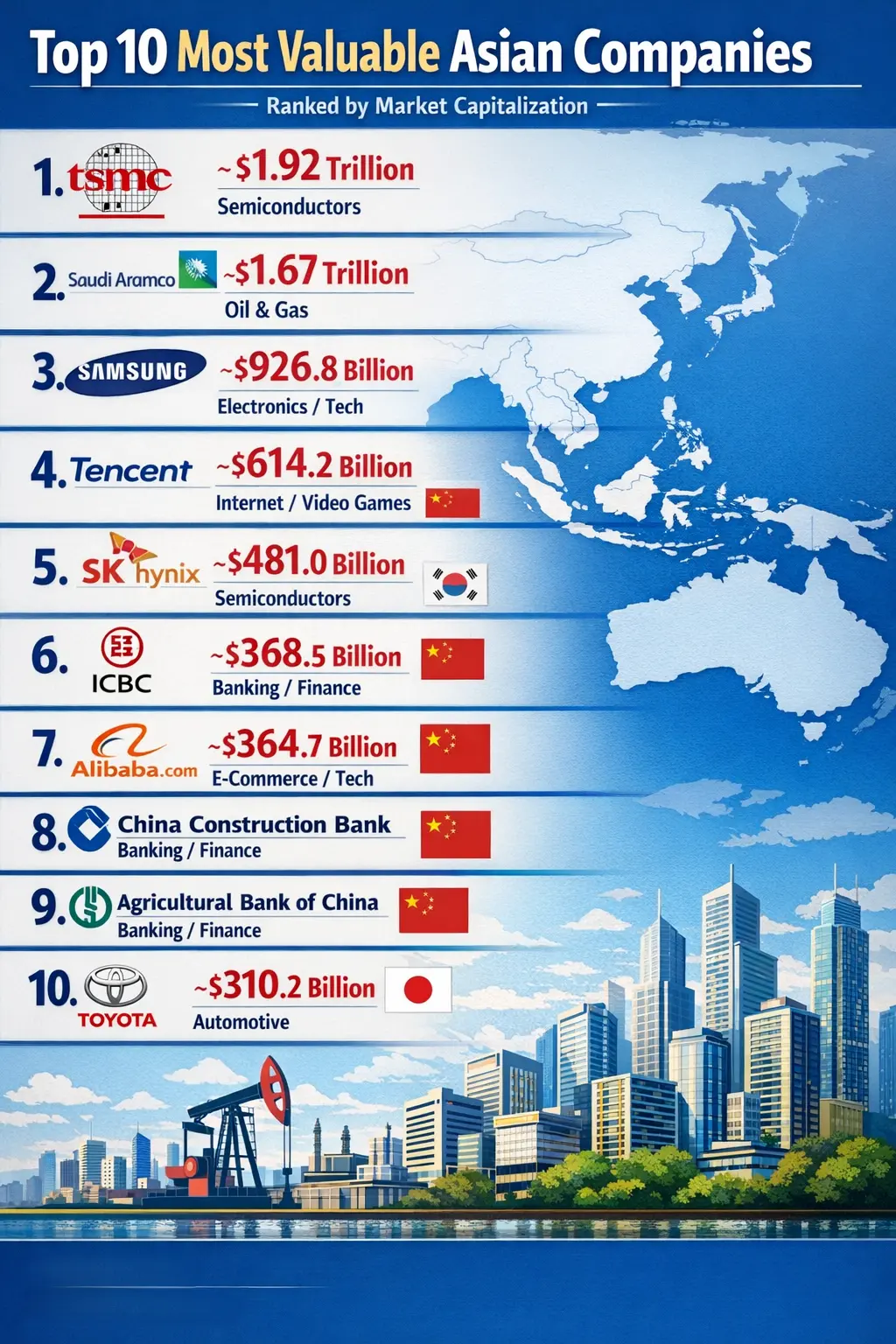
Top 10 (Ranked by Market Capitalisation)
| Rank | Company | Country | Sector | Market Cap (USD) |
|---|---|---|---|---|
| 1 | TSMC | Taiwan | Semiconductors | $1.919T |
| 2 | Saudi Aramco | Saudi Arabia | Energy / Oil & Gas | $1.662T |
| 3 | Samsung Electronics | South Korea | Tech / Electronics | $926.83B |
| 4 | Tencent | China | Tech / Digital Platforms | $614.16B |
| 5 | SK Hynix | South Korea | Semiconductors | $480.95B |
| 6 | ICBC | China | Banking | $368.47B |
| 7 | Alibaba Group | China | E-commerce / Cloud | $364.73B |
| 8 | Agricultural Bank of China | China | Banking | $328.99B |
| 9 | China Construction Bank | China | Banking | $329.4B |
| 10 | Toyota Motor Corp. | Japan | Automotive | $310.24B |
Source: All market capitalisation figures are based on Companies Market Cap data and were last verified in February 2026. Values may change daily.
Company Profiles: Leaders Shaping Asia’s Economic Power
1. Taiwan Semiconductor Manufacturing Company (NYSE: TSM)
- Industry: Semiconductors
- Notable Products/Services: Advanced microchips, semiconductor foundry services
TSMC has emerged as Asia’s most valuable company in 2026, reflecting its near-monopoly over advanced semiconductor manufacturing. The company produces the vast majority of the world’s leading-edge chips used in AI training, data centres, and high-performance computing. Its dominance has turned semiconductor fabrication into a strategic asset comparable to energy production, placing TSMC at the centre of global technology supply chains and geopolitical risk discussions.
2. Saudi Aramco (Tadawul: 2222)

- Industry: Oil & Gas
- Notable Products/Services: Crude oil, natural gas, petrochemicals
Saudi Aramco remains one of the largest companies globally, underpinned by unmatched scale in oil production and ultra-low extraction costs. While global energy markets transition toward renewables, Aramco continues to generate enormous cash flows and plays a decisive role in global energy pricing. Its investments in downstream petrochemicals and alternative energy technologies reinforce its long-term strategic relevance.
3. Samsung Electronics (KRX: 005930)
- Industry: Technology & Consumer Electronics
- Notable Products/Services: Smartphones, semiconductors, home appliances, displays
Samsung Electronics combines leadership in memory semiconductors with global dominance in consumer electronics and display technology. The recovery in memory pricing, driven by AI server demand, has strengthened Samsung’s earnings profile, while its diversified product base provides resilience across economic cycles. The company remains one of Asia’s most globally integrated industrial champions.
4. Tencent (OTC: TCEHY)

- Industry: Technology & Entertainment
- Notable Products/Services: WeChat, QQ, Tencent Games, cloud computing, fintech
Tencent is one of China’s most influential technology platforms, spanning social media, gaming, digital payments, and cloud services. Its ecosystem is deeply embedded in everyday economic activity across China, making it both a technology leader and a financial infrastructure provider. Tencent’s scale highlights the intersection between technology and finance within China’s digital economy.
5. SK Hynix (KRX:000660)

- Industry: Semiconductors
- Notable Products/Services: Advanced microchips, semiconductor foundry services
SK Hynix has surged into Asia’s top five on the back of explosive demand for high-bandwidth memory used in AI training and data-centre infrastructure. The company’s rise underscores how memory chips have become just as critical as logic processors in the AI era, reinforcing Asia’s dominance across multiple layers of the semiconductor supply chain.
6. Industrial and Commercial Bank of China (HKG: 1398)
- Industry: Banking & Financial Services
- Notable Products/Services: Commercial banking, corporate lending, wealth management
ICBC is the world’s largest bank by assets and a cornerstone of China’s financial system. Its lending activities support infrastructure, corporate expansion, and international development projects, including Belt and Road initiatives. ICBC’s scale reflects the central role of state-owned banks in China’s economic model and capital allocation.
7. Alibaba Group Holding Limited (NYSE: BABA)
- Industry: E-commerce, Cloud Computing
- Notable Products/Services: Alibaba.com, Taobao, Tmall, Alibaba Cloud, Alipay
Alibaba is one of the world’s largest e-commerce and technology companies, dominating China’s online retail sector through platforms like Taobao and Tmall. It has also built a strong presence in cloud computing with Alibaba Cloud, which competes with global leaders like Amazon Web Services. Beyond e-commerce, Alibaba’s ecosystem includes digital payments, logistics, and artificial intelligence. The company has faced intense regulatory scrutiny from the Chinese government, including antitrust fines and restrictions on its fintech affiliate, Ant Group. Alibaba has transformed China’s retail landscape, enabling millions of small businesses to thrive online. Its technological innovations in AI, cloud computing, and digital payments have positioned it as a global leader in e-commerce and fintech. Alibaba is expanding internationally, particularly in Southeast Asia and Europe, to reduce reliance on the Chinese market. It is also increasing its focus on artificial intelligence and cloud computing to drive future growth while adapting to China’s evolving regulatory landscape.
Alibabaremainsa pillar of China’s e-commerce and cloud computing ecosystem. Following years of regulatory pressure, the company has stabilised and refocused on profitability and enterprise services. Its cloud division and AI capabilities position Alibaba as a key player in Asia’s digital infrastructure build-out.
8. Agricultural Bank of China (SHA: 601288)
- Industry: Banking & Financial Services
- Notable Products/Services: Retail and commercial banking, rural financial services, investment banking
Agricultural Bank of China (ABC) is one of China’s "Big Four" state-owned banks, playing a crucial role in financing rural development and agricultural modernisation. With an extensive network of branches across China, ABC provides financial services to both urban and rural populations, supporting infrastructure development and economic growth. ABC has faced challenges related to bad loans, particularly in the agricultural and real estate sectors. Additionally, concerns over financial transparency and its deep ties to the Chinese government have raised questions about risk management. The bank is a key driver of financial inclusion in China, helping bridge the gap between rural and urban economic development. Its lending activities support China’s long-term economic growth and modernisation efforts. ABC is investing in digital banking solutions to improve service efficiency and expand its reach in underserved regions. It is also increasing its focus on green finance, funding projects related to sustainable agriculture and renewable energy to align with China’s environmental policies.
9. China Construction Bank (SEHK: 0939, SSE: 601939)

- Industry: Banking & Financial Services
- Notable Products/Services: Corporate banking, personal banking, treasury operations, wealth management, credit cards
China Construction Bank (CCB) is one of China's "Big Four" banks, offering a wide range of financial services to corporate and individual customers. The bank provides products such as corporate loans, personal loans, deposits, wealth management services, and treasury operations. CCB has an extensive domestic network and a growing international presence through branches and subsidiaries abroad.
Established in 1954 as the People's Construction Bank of China, the bank was initially focused on government-funded infrastructure projects. It was renamed China Construction Bank in 1996 and restructured as a joint-stock commercial bank in 2004.CCB was listed on the Hong Kong Stock Exchange in 2005 and the Shanghai Stock Exchange in 2007. The bank's strategic emphasis on innovation, risk management, and international expansion has strengthened its position in the global financial market.
10. Toyota (NYSE: TM)
- Industry: Automotive
- Notable Products/Services: Hybrid and electric vehicles (EVs), autonomous driving technology
Toyota is one of the world’s largest and most influential automakers, known for its reliability, innovation, and leadership in hybrid vehicle technology. The company revolutionised the industry with the launch of the Prius, making hybrid cars mainstream. While traditional gasoline-powered vehicles remain a key part of its business, Toyota has been investing heavily in alternative energy solutions, including electric vehicles (EVs) and hydrogen fuel cell technology. Toyota has played a major role in advancing fuel efficiency and sustainable mobility. Its hybrid technology set the standard for emissions reduction in the automotive industry, influencing global policies on clean transportation. Toyota is accelerating its EV production while continuing to develop hydrogen-powered vehicles as a long-term alternative to traditional batteries. The company aims to achieve carbon neutrality by 2050, with a focus on expanding its sustainable vehicle lineup and investing in next-generation automotive technologies.
Next Three Largest Companies (Ranks 11–13)
Reliance Industries, Meituan, and Kweichow Moutai narrowly miss the top 10 in 2026 but remain influential leaders across energy, digital services, and consumer goods.
11. Kweichow Moutai (China) – $269B
Kweichow Moutai is China’s most valuable consumer brand, benefiting from strong pricing power and cultural significance. Despite a challenging consumption environment, the company continues to generate stable cash flows and expand premium offerings.
12. Reliance Industries (India) – $211B
India’s largest listed company spans energy, retail, and digital services through its Jio platform. Reliance’s scale reflects the rapid expansion of India’s domestic economy and its growing role in global supply chain diversification.
13. Meituan (China) – $63B

Meituan dominates China’s local services ecosystem, covering food delivery, travel, and on-demand services. Its rebound in 2026 reflects improving consumer activity and the growing importance of platform-based logistics efficiency.
Analytical Insights: What the 2026 Rankings Reveal
Semiconductor Boom
TSMC’s rise to the top of Asia’s corporate rankings highlights how semiconductor manufacturing has become the most strategically valuable industry in the AI era. Demand for advanced chips has pushed chipmakers ahead of traditional energy and financial institutions in market value.
Chinese Banking Influence
Four of the top 10 companies are Chinese state-owned or state-linked giants: Tencent, ICBC, Agricultural Bank of China, and China Construction Bank. This underscores the massive scale and systemic importance of China’s financial and digital ecosystems.
Geographic Diversity
The top 10 is dominated by Greater China with five companies, followed by South Korea with 2, and 1 each from Saudi Arabia, Japan, and Taiwan. Despite regional diversity, corporate value remains highly concentrated in a small number of economies.
Global Context
Globally, TSMC and Saudi Aramco consistently rank among the top 10 largest companies in the world, trailing only the “Magnificent Seven” (major US technology leaders such as NVIDIA, Apple, and Microsoft). Their presence reinforces Asia’s central role in both technology and energy supply chains.
Why It Is Important to Know the Best Companies in Asia
Understanding Asia’s largest companies helps investors, analysts, and businesses assess regional economic strength and long-term trends.
- Investment Signals: Leading companies reflect capital flows, investor confidence, and sector leadership across Asia.
- Supply Chain Insight: Firms such as TSMC, Samsung, and Saudi Aramco control critical global inputs in technology and energy.
- Innovation Trends: Asia’s dominance in semiconductors and advanced manufacturing highlights where future growth and disruption are likely to emerge.
- Economic Risk Assessment: Heavy concentration in specific countries and sectors reveals both opportunity and systemic risk.
- Global Benchmarking: These companies serve as reference points for valuation, strategy, and long-term market positioning.
Conclusion
Asia’s economic influence is undeniable, with the region housing some of the world’s most powerful companies across technology, finance, energy, and manufacturing. Firms like Tencent and TSMC continue to drive innovation and global business trends.
Looking ahead, the region’s corporate landscape will be defined by technological progress, sustainability efforts, and shifting geopolitical dynamics. With China and India at the forefront and Southeast Asia on the rise, Asia’s role in global markets will only expand. For investors and business leaders, one thing is certain—the future of business is unfolding in Asia.
Looking to trade in Asia’s booming markets? Start trading indices with Hantec Markets today and stay ahead of the financial curve!
Learn more about the biggest companies in different countries and regions around the world by reading our other articles:
- Top 10 Largest US Companies by Market Capitalisation
- Top-10 largest non-US companies by market capitalisation
- 10 Biggest UK-based Companies
- Africa’s Top-10: Leading Companies by Market Capitalisation
- Top 10Largest Latin American Companies
- Economic Powerhouses: Trillion-Dollar Companies Club
- Top 10 Largest Companies in China
- Top 10 Largest Companies in India
Also, we recommend you to find out with our Trader’s Guide to the 10 Major Global Economies by GDP.
Top 5 Blogs