 Balance Guard
Day Trading Strategy: A Structured Approach in 2026
The Reality of 2026 Markets
According to regulatory disclosures and broker performance data, between 70–90% of retail CFD traders lose money within their first year.
This isn't because the markets are "impossible," but because most participants approach trading as speculation rather than a controlled process. In an era where algorithmic execution dominates liquidity and news is priced in within seconds, relying on instinct is a recipe for failure.
What Is a Day Trading Strategy?
A strategy is a non-emotional, rules-based plan for buying and selling assets within a single session. Instead of guessing, successful traders—the 5% who remain profitable—rely on repeatable systems that define:
- Entry Signals: Exactly when to get into a trade.
- Profit Targets: When to take money off the table.
- Hard Stops: When to exit to protect capital.
- Position Sizing: Exactly how much to risk based on the 1% rule.
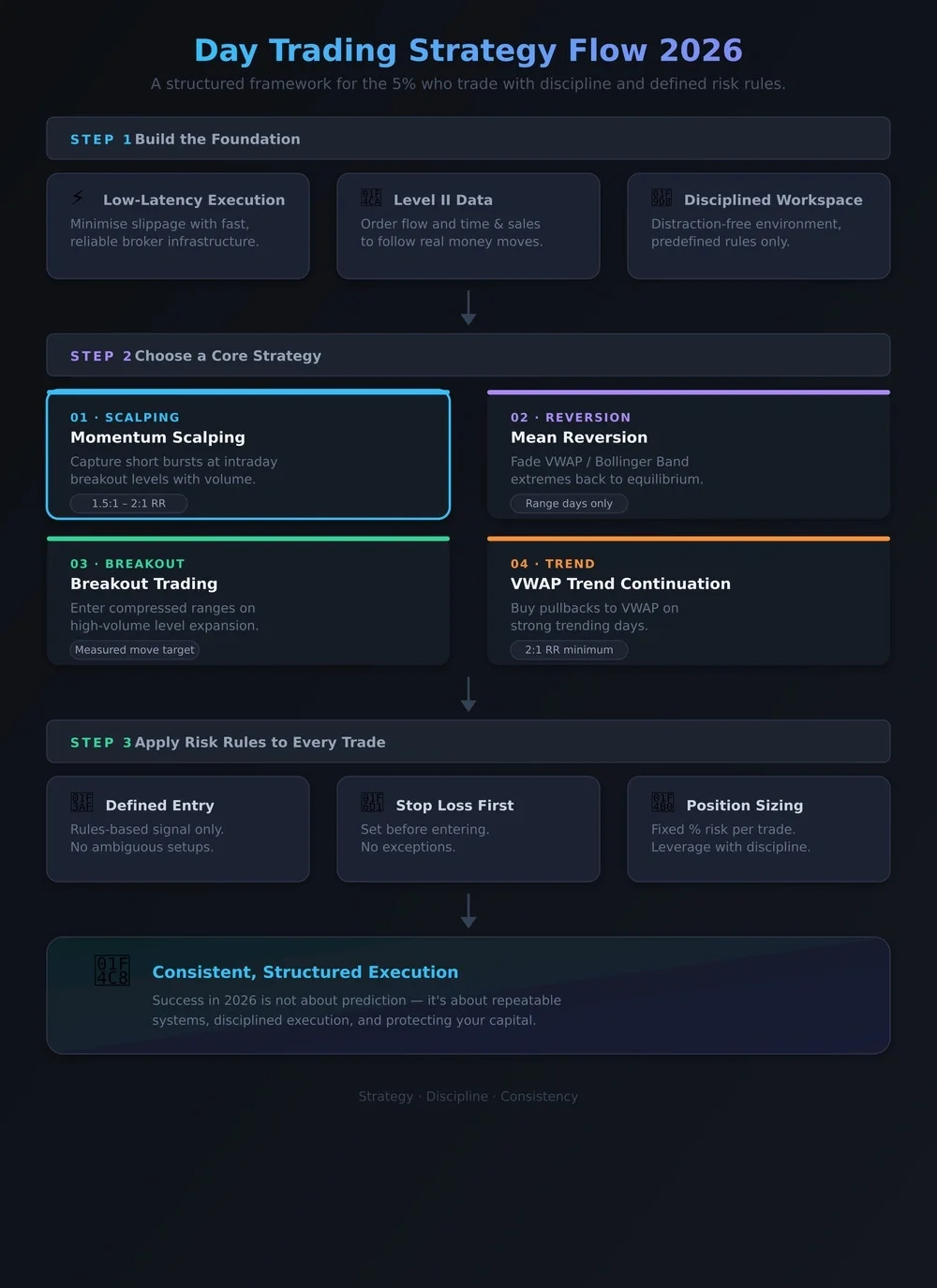
The goal of a day trading strategy is consistency and risk control — not prediction. Successful traders rely on repeatable rules and disciplined execution rather than impulse decisions.
In modern markets, where prices move quickly and news spreads instantly, having a structured plan is essential. Without a strategy, day trading becomes speculation instead of a controlled process.
From Pattern Day Trader Rules to Risk-Based Margin
In the past, much of the conversation around day trading centred on Pattern Day Trader restrictions and capital minimums. Today, many brokers operate using risk-based margin frameworks that assess exposure dynamically.
This evolution creates more flexibility for traders, but also increases responsibility. Leverage amplifies both profits and losses. Without strict risk parameters, a small mistake can escalate quickly.
If you are trading with a live account, ensure your brokerage environment provides transparent margin calculations, fast execution, and integrated risk controls. Ensure your brokerage environment provides transparent margin calculations, reliable execution speed, and integrated risk management tools.
The Must-Haves for a Serious Day Trader
Before choosing a strategy, your infrastructure must be solid:
- Low-latency execution to minimise slippage
- Level II data and time and sales for order flow analysis
- A dedicated trading workspace free from distractions
Professional execution begins with professional preparation.
Strategic Deep Dive: The Core Day Trading Frameworks
Every strategy requires two essential components:
- A clear entry signal
- A predefined exit logic for both profit and loss
Without both, trading becomes emotional and inconsistent.
1. Momentum Scalping
- Concept Capture short bursts of aggressive buying or selling pressure.
- Signal Break of intraday resistance or support with strong volume expansion.
- Entry Enter as price clears the level with confirmation from order flow.
- Stop Placed just beyond the breakout candle.
- Target Fixed reward-to-risk ratio such as 1.5:1 or 2:1, or exit on momentum exhaustion.
Momentum scalping focuses on speed and precision. It requires discipline and quick execution. Overtrading this strategy often leads to performance decay.
2. Mean Reversion
- Concept Price extends away from equilibrium and then returns.
- Signal Significant extension from VWAP or Bollinger Bands with fading momentum.
- Entry After a reversal structure forms near the extreme.
- Stop Placed beyond the recent high or low.
- Target Return toward VWAP or the midpoint of the range.
Mean reversion works best in consolidating markets. Attempting to fade strong trend days can lead to repeated losses.
3. Breakout Trading
- Concept Low volatility compresses price until expansion occurs.
- Signal Tight consolidation with clearly defined resistance or support.
- Entry Break of the range with strong volume confirmation.
- Stop Placed inside the consolidation structure.
- Target Measured move projection or trailing stop as volatility expands.
Breakout trading rewards patience. Entering too early often results in false breakouts.
4. VWAP Trend Continuation Strategy
- Concept Trade in the direction of the trend when price pulls back to VWAP (Volume Weighted Average Price) and resumes momentum.
- Best Market Condition Strong trending days with steady volume.
- Signal Price pulls back toward VWAP without breaking below it (in an uptrend), followed by bullish confirmation.
- Entry Enter when price resumes upward movement after holding VWAP.
- Stop Placed slightly below VWAP or below the recent pullback low.
- Target Previous intraday high or a 2:1 reward-to-risk ratio.
VWAP continuation captures the "meat" of a trend. Success depends on distinguishing a true pull-back from a full trend reversal.
5. News-Based Volatility Strategy
- Concept Trade price expansion immediately following high-impact economic news or earnings releases.
- Best Market Condition Scheduled news events with confirmed volatility.
- Signal Sharp price movement with strong volume immediately after news release.
- Entry Enter only after initial volatility stabilizes and direction becomes clear.
- Stop Placed beyond the first volatility spike.
- Target Ride momentum until volume decreases or structure breaks.
News trading offers high reward potential but carries extreme slippage risk. It is a high-stress strategy that demands strict capital preservation.
Important for Beginners: This strategy requires caution. News events can cause unpredictable spikes. Risk must be tightly controlled.
6. Pullback to Support/Resistance Strategy
- Concept Trade retracements within an established trend when price returns to a previously broken support or resistance level.
- Best Market Condition Moderate trend days.
- Signal Price breaks a key level, then retests it and holds.
- Entry Enter after confirmation that the level is respected (rejection candle or higher low).
- Stop Placed just beyond the retested level.
- Target Continuation in the direction of the trend.
Pullback trading provides excellent risk-to-reward entries. The challenge lies in waiting for a clean retest rather than chasing the initial move.
Why It’s Beginner-Friendly
- Easy visual identification
- Logical stop placement
- Teaches patience and confirmation
Which Strategy Is Best for Beginners?
There is no single “best” day trading strategy. The best strategy is the one that:
- Has clear rules
- Limits risk to 1% or less per trade
- Can be repeated consistently
- Matches your available screen time
For most beginners, breakout trading and the opening range breakout are the easiest to structure and manage.
In 2026, success in day trading is less about finding a secret indicator and more about executing a simple strategy with strict risk control.
| Strategy | Best Market Condition | Skill Level | Trade Frequency | Risk Level | Main Advantage | Main Risk |
|---|---|---|---|---|---|---|
| Momentum Trading | Strong trending markets / High volume | Beg–Int | Moderate | Medium | Captures directional moves | False breakouts |
| Breakout Trading | Tight consolidation | Beginner | Low–Mod | Medium | Clear entry levels | Low volume fakes |
| Mean Reversion | Sideways / Range-bound | Beg–Int | Moderate | Medium | Logical targets | Strong trend days |
| Opening Range | High volatility (Open) | Beginner | Low | Medium | Reduced overtrading | Choppy whipsaws |
| VWAP Trend | Strong trend days | Intermediate | Moderate | Medium | Institutional flow | VWAP breakdown |
| News-Based | Earnings / Economics | Advanced | Low | High | Large, fast moves | Slippage/Volatility |
Risk Management: The Non-Negotiables
No strategy works without disciplined risk control.
The 1% Rule
Never risk more than 1% of your trading account on a single trade.
If your account size is $10,000, your maximum loss per trade should be $100. This prevents emotional damage during losing streaks and protects capital longevity.
Position Sizing Formula
Professional traders calculate position size using a structured formula:
Example:
Account size: $10,000 Risk per trade: $100 Entry price: $50 Stop loss: $49
Risk per share equals $1. Position size equals 100 shares.
This formula removes emotion from sizing decisions.
Hard Stop Versus Mental Stop
Hard Stop
A broker-executed stop-loss placed immediately after entry.
Mental Stop
A self-imposed exit level executed manually.
Mental stops fail under pressure. Hard stops enforce discipline automatically.
The Psychological Edge
Technical knowledge is necessary. Emotional discipline is decisive.
Trading Tilt
Trading tilt, often referred to as revenge trading, occurs when frustration override's structure.
Common warning signs:
- Increasing position size after a loss
- Ignoring setup criteria
- Trading during low-volume periods out of boredom
- Feeling urgency instead of patience
Tilt does not feel reckless in the moment. It feels justified. That is why it is dangerous.
The Importance of a Digital Journal
Improvement requires data.
A structured digital trading journal allows you to track:
- Setup type
- Entry and exit quality
- Risk-to-reward ratio
- Time-of-day performance
- Emotional state
Patterns quickly emerge. Many traders discover their worst decisions occur after consecutive losses or during midday volume contraction.
Self-awareness converts mistakes into measurable feedback.

The Comparison Matrix
Day Trading vs Scalping: The Speed Rivalry
Scalping requires rapid reflexes and constant engagement. Day trading allows slightly more time for confirmation and structured risk planning.
Day Trading vs Swing Trading: The Lifestyle Rivalry
Day trading eliminates overnight exposure. Swing trading requires less screen time but introduces gap risk. The correct choice depends on temperament and availability.
Day Trading vs Trend Following: The Magnitude Rivalry
Trend following aims to capture major directional moves over months. Day trading captures intraday fluctuations. One prioritises magnitude, the other frequency.
Both approaches require discipline. Neither tolerates poor risk management.
Real-Life Examples
Example Case Study 1: The Momentum Win
Scenario
A technology stock releases stronger-than-expected earnings before the open.
The Setup
The stock gaps up 4% at the open. The trader waits for the first 15-minute candle to close, defining the Opening Range.
The Action
Price breaks above the 15-minute high with strong volume expansion. The trader enters on confirmation.
The Risk Management
Stop-loss is placed just below the VWAP line.
The Result
The stock trends upward through the morning session. The trader exits when price reaches the Upper Bollinger Band, capturing a 2.5:1 reward-to-risk ratio.
The lesson is patience and precision.
Example Case Study 2: The Over-Trading Trap
Scenario
A beginner trader starts the day with a $5,000 account and takes a $50 loss.
The Mistake
They increase position size to recover the loss and ignore setup criteria.
The Spiral
Multiple low-quality trades follow during a low-volume period.
The Result
By 2:00 PM, the trader has lost $450, or 9% of the account.
The Takeaway
A daily stop-loss rule is more important than any strategy. Without a predefined maximum daily loss, emotion compounds damage quickly.
Final Thoughts
Day trading is not about constant action. It is about controlled execution within defined risk parameters. The 5% who succeed do not predict better. They manage risk better. They stop trading when discipline fades. They document every trade and refine their process continuously.
In 2026, the edge belongs to structured traders. Build your framework. Protect capital with mathematical precision. Use the right tools. If you are developing your strategy, start with a demo environment and graduate to live capital only when your process is consistent.
Professional trading is engineered, not improvised.
Frequently Asked Questions
What is the most effective strategy for a beginner to use in 2026?
There is no single "best" day trading strategy. However, for most beginners, breakout trading and the opening range breakout are the easiest to structure and manage. The most effective strategy is one that has clear rules, limits risk to 1% or less, and matches your available screen time.
Why is the 1% risk rule so important?
The 1% rule ensures you never risk more than 1% of your trading account on a single trade. This discipline is vital because it prevents emotional damage during losing streaks and protects your capital longevity.
What is the difference between a hard stop and a mental stop?
A hard stop is a broker-executed order placed immediately after entry that enforces discipline automatically. A mental stop is a self-imposed exit level executed manually. Mental stops are dangerous because they frequently fail under pressure, whereas hard stops protect capital without emotional interference.
Top 5 Blogs