 Balance Guard
The Top 8 Trading Strategies for 2026: Which One is Best for You?
Updated on January 2026 by Syed Maaz Asghar.
Whether you are new to trading or already have some experience, choosing the right trading strategy can feel overwhelming. You may be searching for a beginner-friendly method, trying to understand more advanced trading concepts, or simply looking for an approach that suits your goals and trading style.
Looking for a beginner-friendly trading strategy?
Are you searching for a specific trading strategy?
Learning about advanced trading concepts?
Tried many and want to find the most effective trading method?
In this article, we present the most popular trading strategies and explain how both beginner and experienced traders can use them effectively.
It could be argued that there are as many trading strategies as there are traders. Every trader has their own individual approach and traits that are particular to them. However, there are some broader approaches to trading which have become popular over decades. These tried-and-tested methods continue to be used by traders worldwide. Find out more about these different trading approaches and discover the best trading strategy for you.
Table of Contents
- What Are Trading Strategies?
- What Is Position Trading and How Do Beginners Use It?
- What Is Swing Trading and Why Do Traders Like It?
- What Is Day Trading and Can Beginners Do It?
- What Is Price Action Trading and Why Is It So Popular?
- What Is Algorithmic Trading and Is It Only for Professionals?
- What Is News Trading and How Does It Actually Work?
- What Is Trend Trading and Why Does It Work So Well?
- What Is Range Trading and When Should You Use It?
- Key Components of a Trading Strategy
- Developing a Successful Trading Strategy
- Trading Strategy Summary
- Which Trading Strategy Is Best for You?
- Best Platform for Different Trading Strategies
- FAQ
What Are Trading Strategies?
Trading strategies are systematic approaches employed by traders to make informed decisions in financial markets. They are step-by-step approaches that help traders capture opportunities among volatilities in the market and manage their risk.
Trading strategies can be short-term or long-term, depending on the time horizon of the trades, and they often involve setting:
- Specific entry and exit points
- Position sizing
- Trading time frames
- Risk management rules
By using trading strategies, traders can decide when to buy and sell, what volume to trade, and how to protect themselves from big losses.
What Is Position Trading and How Do Beginners Use It?
Position trading is a long-term strategy where traders hold positions for days or weeks to capture major market trends, ideal for beginners who prefer minimal screen time and a strategic, big-picture approach.
Position trading involves taking a position aligned with the primary trend over a short to intermediate-term time frame, usually defined on a daily chart. To use the popular trading metaphor, the trend is your friend.
While various approaches can be employed, the core principle revolves around holding positions for several days or even weeks. This strategy capitalises on major market movements and trends.
Pros of position trading:
- Position trading doesn't need constant attention, which can be less stressful for traders compared to shorter-term strategies.
- By focusing on the bigger picture, position traders can catch major market trends and potentially earn significant profits.
- Position traders aren't bothered by the day-to-day market ups and downs, which can help them make calmer decisions.
Cons of position trading:
- It might take a while to see the results of a position trade, and tying up money in a trade for a long time might not be suitable for everyone.
- Short-term changes that aren't visible on a daily chart might impact position traders without them realising.
- Position trading can also mean sticking with a losing trade for longer if the trend goes against your view, potentially leading to bigger losses.
Market suitability: Best for stocks, commodities, and major cryptocurrencies with clear long-term trends.
Time commitment: Around 1–3 hours per week to monitor positions.
Recommended skill level: Intermediate to advanced.
What Is Swing Trading and Why Do Traders Like It?
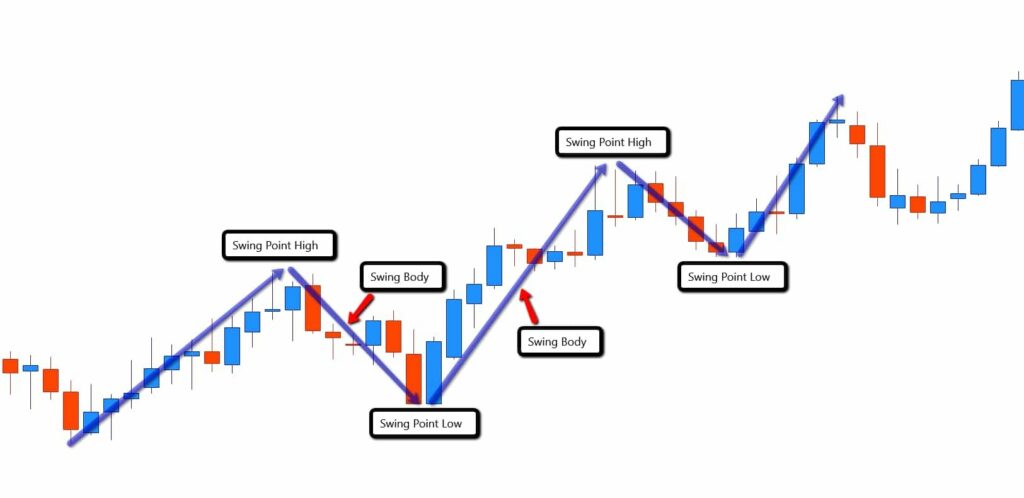
Swing trading aims to profit from short-term price "swings" over a few days to weeks, offering a balanced mix of activity and flexibility that suits part-time traders.
Swing trading is like position trading, but the swing trader would look to identify swings in both directions within the primary trend. Swing trading is typically done on a short-term basis, as opposed to an intermediate or longer-term time frame.
Typically, swing traders would hold views and positions in a market for a couple of days, or for 1–2 weeks. Both position and swing traders often use trading strategies, like trend trading, counter-trend trading, momentum trading or breakout trading.
Pros of swing trading:
- Placed between short-term day trading and long-term investing, swing trading allows traders to capture price moves over a few days to weeks.
- By aiming to catch price swings within trends, swing traders can benefit from both upward and downward market movements.
- Swing trading doesn't demand the constant attention needed in day trading. This reduces the pressure on traders, making it more accessible to those with full-time jobs or other commitments.
Cons of swing trading:
- Holding positions for several days exposes traders to overnight market movements and potential gaps, which could lead to unexpected losses.
- Swing traders might not catch every short-term price movement, potentially missing rapid market fluctuations that occur within their chosen time frame.
- Swing traders may find it challenging to predict and adapt to sudden shifts in market sentiment or unexpected news events that can disrupt their planned trades and strategies.
Market suitability: Best for stocks, Forex pairs, and cryptocurrencies.
Time commitment: Around 1 hour per day to scan and manage positions.
Recommended skill level: Beginner to intermediate.
What Is Day Trading and Can Beginners Do It?
Day trading involves opening and closing all trades within a single day and is generally not recommended for beginners due to its high intensity, emotional demands, and need for experience.
Day trading is simply trading within the day. The key characteristics of a day trader is that they open and close their open trading positions within the same trading day. This does not imply that day traders only execute one trade per day. In fact, most day traders have tactics where they buy and sell frequently throughout each trading day.
A key feature of day trading is to be "flat" at the end of the day. This means the day traders have closed out of all open positions before the end of the trading day. Day traders often use technical analysis as a key tool, employing technical indicators like RSI, MACD, and the Stochastic Oscillator, to help identify market conditions and assist with trading decisions.
Pros of day trading:
- Day trading aims to capitalise on short-term price movements within a single day, providing opportunities for faster earnings.
- Day trading eliminates the risk of being exposed to overnight market volatility or unexpected news events that can impact their trades.
- Day trading doesn't tie up capital for extended periods, allowing traders to access their funds at the end of each trading day. This can be appealing for those who prefer more liquidity.
Cons of day trading:
- The fast-paced nature of day trading can be mentally and emotionally demanding for trader, and new traders may be prone to impulsive decision-making.
- Short-term price movements can be influenced by random fluctuations, making it challenging to distinguish between meaningful trends and temporary market movements.
- Frequent buying and selling in day trading can lead to higher transaction costs, including commissions and fees.
Market suitability: Best for Forex, major stocks, and index futures with strong intraday volatility.
Time commitment: Usually 4–8 hours per day during trading hours.
Recommended skill level: Intermediate to advanced.
What Is Price Action Trading and Why Is It So Popular?
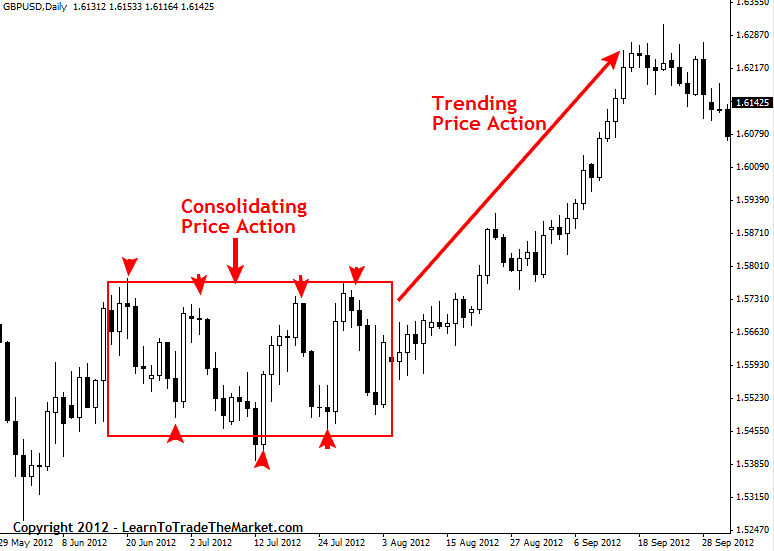
Price action trading focuses solely on raw price movements, without indicators, making it a clean, adaptable, and widely used method across markets and time frames.
Price action trading is simply trading the price action, which is the various moves, changes and shifts in price over differing time frames. Price action traders identify how these price changes build into price trends or price patterns, then trade with the price action.
First, it is necessary to decide on the time frame that you want to trade on, and then identify which price action trading strategy you are going to use. Price action traders look for the dominant price action on their time frame, recognise the trend or the pattern that is dominant, then enter trades in the direction of the price action signal.
Pros of price action trading:
- Price action trading relies on price movements on a chart, without the need for complex indicators or tools.
- Price action traders study patterns, trends, and candlestick formations to understand market psychology and sentiment, potentially providing insights into future price movements.
- Price action principles can be applied to various markets and time frames, making it versatile for traders interested in stocks, forex, commodities, and more.
Cons of price action trading:
- Analysing price action patterns can be subjective, as different traders might interpret the same chart differently.
- Effectively understanding price action patterns and trends often requires experience and a deep understanding of market dynamics.
- Price action patterns are not foolproof indicators and can sometimes generate false signals, leading to incorrect trading decisions.
Market suitability: Works well for forex, stocks, crypto, and commodities.
Time commitment: Typically, 1–2 hours per day to analyse charts and plan trades.
Recommended skill level: Beginner to advanced, depending on pattern complexity
What Is Algorithmic Trading and Is It Only for Professionals?
Algorithmic trading uses computer programs to execute trades based on predefined rules. It's most common among professionals but increasingly accessible to skilled retail traders.
Algorithmic trading or algo trading is a strategy where a set of commands is determined and entered into a computer model. It is an automated trading process that uses data such as price, time and trading volume, plus complex formulas and mathematical models.
Algorithmic trading uses a rules-based strategy, where the definition of the rules is a critical input. The objective is to produce signals to buy or to sell, when and at what price to enter a trade, when and where to take profit or to place a stop-loss.
There is usually limited or no human interaction after the initial rules are defined by the algorithmic trader, though these rules are usually refined by the trader.
Pros of algo trading:
- Algorithms execute trades with exceptional speed, reacting to market changes in milliseconds. This speed can exploit short-lived opportunities and execute large orders more efficiently than manual trading.
- Algo trading removes the emotional biases that may affect human decisions. It follows predefined rules and strategies, preventing trading by feelings or impulses.
- Algorithms can be back-tested using historical data to assess their performance under different market conditions. This helps traders refine and optimise strategies before deploying them in real markets.
Cons of algo trading:
- Developing, implementing, and maintaining algorithmic trading systems require advanced technical skills and knowledge.
- Algorithms are susceptible to technical glitches, bugs, and connectivity issues that can lead to unintended trades if not adequately monitored and managed.
- Algorithms might struggle to adapt to unexpected news events or drastic market shifts, leading to unforeseen losses.
Market suitability: Best for forex, stocks, and large-scale cryptocurrency trading where liquidity is high.
Time commitment: High at setup and testing, then minimal daily oversight.
Recommended skill level: Advanced only.
What Is News Trading and How Does It Actually Work?
News trading involves making trades based on scheduled or breaking economic or corporate news releases to profit from short-term volatility spikes.
News trading relies on fundamental events that can impact any financial market. This might be corporate events such as earnings reports, or a larger macroeconomic, fundamental event that might impact any market.
News traders first look to identify possible macroeconomic or corporate events that are scheduled such as economic data or earnings release. They then analyse the potential impact of these events, the likely trading consequences and then shape a strategy around the event. News traders also seek to take advantage of market volatility due to breaking news.
The aim is to profit from price changes before, during or after the event.
Pros of news trading:
- Major news events can trigger substantial price movements, creating the opportunity for significant potential earnings in a short time span.
- News traders concentrate on specific events and their potential impact, allowing them to focus on a defined set of factors rather than the broader market.
- News traders thrive in volatile markets, where sudden price fluctuations are common. This volatility can lead to rapid price changes, providing opportunities for quick gains.
Cons of news trading:
- News trading carries substantial risk due to the unpredictable nature of market reactions to news events.
- Markets might react erratically to news, with prices swinging back and forth before settling into a direction. This can lead to false signals for traders.
- Executing trades at the precise moment of a news release can be challenging due to the speed at which prices change. Delays in execution can result in missed opportunities or unfavourable trades.
Market suitability: Best for forex, stocks, and indices during earnings or economic releases.
Time commitment: Event-driven; requires planning before, and monitoring during and after news events.
Recommended skill level: Intermediate to advanced.
What Is Trend Trading and Why Does It Work So Well?
Trend trading follows the market's dominant direction, buying in uptrends and selling in downtrends, and works well because markets often move in sustained trends over time.
Trend trading is a strategy that aims to capture market opportunities by identifying and following the direction of the market. Traders seek to enter positions in the direction of the trend and hold them until the trend shows signs of reversal.
This approach relies heavily on the principle that markets tend to move in identifiable trends rather than random patterns. Trend traders use various tools and indicators to confirm the trend's direction and strength, such as moving averages, trendlines, and the Average Directional Index (ADX).
Trend traders focus on higher highs and higher lows in an uptrend, and lower highs and lower lows in a downtrend, while entry points are typically based on pullbacks or breakouts.
Pros of trend trading:
- Entry and exit points are based on trend continuation or reversal signals, which can simplify decision-making.
- Trend trading often follows a rule-based system, making it easier to manage emotions and adhere to a trading plan.
- By focusing on the broader market direction, trend trading can help reduce market noise by filtering out short-term volatility.
Cons of trend trading:
- Tools like moving averages can cause delayed entries and exits, potentially missing parts of the move.
- In choppy markets, trends can reverse quickly, leading to the risk of whipsaw losses.
- Trend trading may be less effective in ranging or sideways markets where trends are not clearly defined.
Market suitability: Stocks, commodities, and forex pairs with long directional moves.
Time commitment: Around 2–4 hours per week to monitor trades.
Recommended skill level: Beginner to intermediate.
What Is Range Trading and When Should You Use It?
Range trading profits from price oscillations between support and resistance levels and works best in sideways, non-trending markets.
Range trading is a strategy where traders identify securities trading between two prices, known as support and resistance levels. The strategy involves buying at the support level (bottom of the range) and selling at the resistance level (top of the range).
This approach assumes that prices will continue to oscillate between these established levels until a breakout occurs. Range traders focus on markets that lack a clear long-term trend and instead move within a bounded range.
Key tools include oscillators such as RSI and Stochastic, which help identify overbought and oversold conditions within the range. Range traders also watch for volume changes and other signs of potential breakouts.
Pros of range trading:
- Range-bound markets offer multiple trading opportunities as prices oscillate within the range.
- Support and resistance make for well-defined entry and exit points.
- Range trading can be helpful in markets that are not trending, where other strategies may have a higher likelihood of failure.
Cons of range trading:
- Profits are capped by the range boundaries, unlike trend trading, where gains can be larger.
- Traders need to frequently watch the market to identify valid ranges and breakout points.
- Prices can break out of the range unexpectedly or generate false signals, especially in volatile markets where prices spike.
Market suitability: Forex, stocks in sideways conditions.
Time commitment: About 1 hour per day to monitor ranges.
Recommended skill level: Beginner to intermediate
Key Components of a Trading Strategy
A robust trading strategy is built on several essential elements, each designed to help you trade with consistency and discipline:
- Market selection: Decide which financial markets best fit your interests and skills. For example, forex suits traders who want high liquidity and extended trading hours, while stocks may appeal to those who prefer following earnings reports and fundamentals.
- Trading timeframe: Choose a timeframe that aligns with your lifestyle and risk appetite. Are you looking for quick, intraday moves or long-term trends that take weeks to develop?
- Entry and exit criteria: Set clear, objective rules for when you will open and close a trade. This can include technical signals, candlestick patterns, or fundamental events.
- Risk management rules: Define exactly how you will protect your capital, using tools like stop-loss orders, proper position sizing, and limits on the amount you're willing to risk per trade.
- Performance evaluation: Track your trades over time to measure profitability, win/loss ratios, and consistency. Performance tracking helps you understand what is working and what needs improvement.
- Adaptation and continuous improvement: Markets change, so a good strategy must be flexible. Schedule periodic reviews to adjust and refine your trading plan, responding to new market conditions and lessons learned.
Developing a Successful Trading Strategy
Building a trading strategy from scratch takes careful planning and patience. Follow these seven steps to develop one that is realistic and sustainable:
- Define your trading objectives and risk profile: Are you aiming for growth, income, or preservation of capital? Know how much risk you are comfortable taking.
- Choose a market and timeframe that match your lifestyle: Align your chosen market (e.g., forex, stocks, crypto) and your preferred trading timeframe (scalping, swing trading, etc.) with your schedule and availability.
- Research and design a strategy with clear rules: Study how the market behaves, then create a set of entry, exit, and risk rules based on patterns or data you trust.
- Backtest on historical data: Before risking real money, check how your strategy would have performed in the past. Look for drawdowns, win rates, and average profits.
- Practice on a demo account: Simulate live conditions without risking capital. This helps you build confidence and spot practical flaws in your plan.
- Deploy live with small positions: Transition to a real account gradually, using small trades to build experience without exposing yourself to large losses.
- Monitor, review, and refine regularly: Keep a trading journal, analyse your results, and adjust your strategy as needed to keep pace with changing market conditions.
Traditional strategies are evolving fast — and AI is leading that transformation. Learn how to enhance your trading playbook with AI-driven prompts designed for real market conditions in our latest article, Unlock Your Trading Superpower: 10 AI Prompts to Boost Your Forex and Stock Trading Game.
Trading Strategy Summary
| Strategy | Pros | Cons |
|---|---|---|
| Swing Trading | - Captures medium-term price movements - Less screen time needed |
- Requires patience - Exposed to overnight risk |
| Position Trading | - Long-term focus - Less frequent trades - Less stressful |
- Requires strong market knowledge - Ties up capital for long periods |
| Day Trading | - No overnight risk - High potential profits from volatility |
- Time-consuming - High emotional and psychological pressure |
| Price Action Trading | - Clean charts, no indicators - Adaptable to all markets |
- Requires deep understanding of price behavior - Subjective entries |
| Algorithmic Trading | - Automated and fast execution - Emotion-free trading |
- Requires coding skills - Expensive to set up and backtest |
| News Trading | - Takes advantage of volatility spikes - Quick profits possible |
- High risk due to slippage - Requires fast execution tools |
| Scalping | - High number of small wins - Minimal exposure per trade |
- Very intense and time-consuming - High costs due to spreads |
| Trend Following | - Captures large market moves - Simple rules often used |
- Ineffective in sideways markets - Late entries/exits |
Which Trading Strategy Is Best for You?
There are several factors to consider when deciding on what trading strategy suits you best. These include:
- Your individual psychology and make up
- Your trading aims and goals
- The time you can devote to trading
- What "feels" right
Your personal psychology and background: It would be useful to first look at what you do and as important what you don't bring as an individual to trading, from a psychological and personal perspective.
For example, if you do not have strong computing skills then algorithmic trading is not for you. If you do have a strong analytical brain, then news trading may be a viable choice for you. If looking at charts to make decisions comes naturally to you, then perhaps swing or position trading, even day trading, would be a good fit for you.
Your trading goals: Are you looking to trade full time and make trading your primary source of income? If the answer is yes, then you would need to look at short-term trading such as day trading. But if you are looking to make top-up income, position or swing trading might be a better fit.
Time required: If you cannot follow markets closely throughout the day, then you cannot be a day trader. If you can give limited time each day to analyse markets and place orders, then maybe position or swing trading is a good fit.
What "feels" right: Try out different trading strategies using a demo account to determine which approach suits you and what strategy is profitable.
Best Platform for Different Trading Strategies
If you're unsure of how to get started with these different trading strategies or want to test a new strategy, you can do so on a demo account with zero risk to your capital.
Demo accounts are a great way to try new strategies in live market conditions and see what their outcomes could have been without risking actual capital. You can also practice on a demo account until you gain confidence in your ability to successfully trade your capital in real market conditions.
With Hantec Markets, you can sign up for a demo account and get access to the MetaTrader4® and MetaTrader 5® for a seamless trading experience with the right tools by your side.
Want to get straight to trading? Open a live Hantec Markets account in minutes and start trading!
You can also read about avoiding common mistakes that retail traders make and how to build a successful trading plan.
Also, read about avoiding common mistakes that retail traders make and get nine tips for new Forex traders and learn how to build a successful trading plan.
FAQ
Q: What are the key differences between swing trading and day trading?
A: Swing traders hold positions for several days or weeks, while day traders open and close positions within the same day. Swing trading needs about 1 hour of daily monitoring, while day trading can demand a full day of focus.
Q: How can traders use price action strategies effectively?
A: By mastering support/resistance, candlestick patterns, and chart trends. Price action works best with a clean chart, clear rules, and solid risk management.
Q: Is algorithmic trading suitable for beginners or only for advanced traders?
A: Algorithmic trading is usually only for advanced traders, due to coding, testing, and monitoring requirements. Beginners should master manual trading first.
Q: What factors should be considered when choosing a trading strategy?
A: Think about your time commitment, market preference, risk tolerance, skill level, capital, and ability to stay disciplined under pressure.
Top 5 Blogs